Why a Low-Yield Well Can Still Supply Plenty of Water
If you've been told that your home has a low-yield well, it is easy to assume that you simply don't have enough water. A well producing only 0.5, 1, or 2 gallons per minute sounds inadequate when you compare it with the amount of water a modern household can use during showers, laundry, dishes, and other everyday activities. In many cases, however, the problem is not that the well fails to produce enough total water. The real problem is that the well produces water slowly while the house wants to use it very quickly.
That difference is exactly why a low-yield well can still be a perfectly usable water source. Even a well producing a relatively small amount of water every minute can accumulate hundreds of gallons over the course of a day. What it cannot do is instantly provide the high flow rates a household may demand during a busy morning or evening. A shower, washing machine, toilet, and sink can easily require several times more water per minute than a low-yield well can produce.
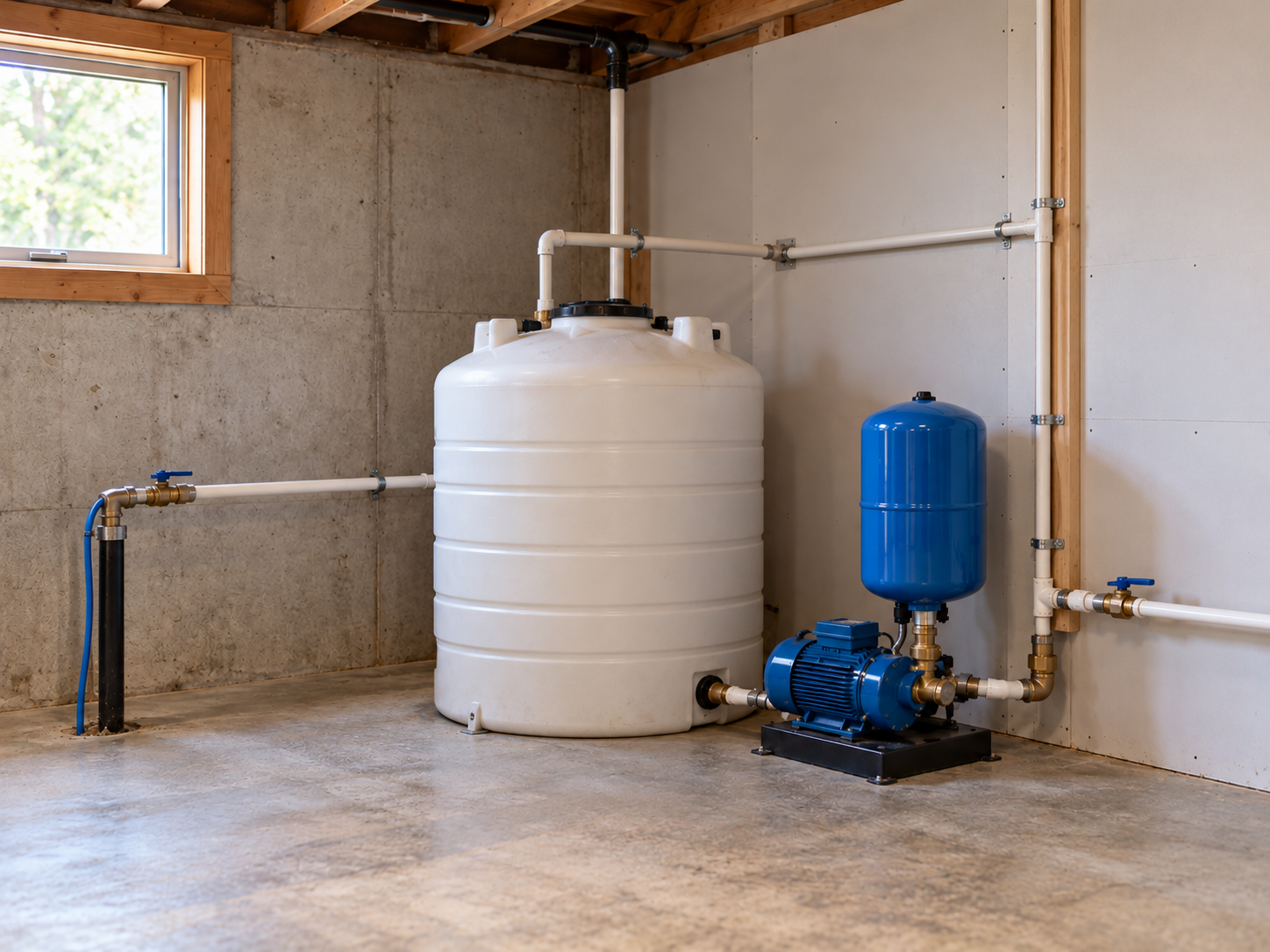
This is where the Well Harvester® changes the way a low-yield well can be used. Instead of depending on the well to directly supply the home every time someone opens a faucet, the Well Harvester collects the water the well is capable of producing, stores it, and then supplies the house from that stored reserve. The well can produce slowly while the home continues to use water at normal household pressure and flow.
For many homeowners, that means a low-yield well does not necessarily need to be replaced. It needs to be managed differently.
What Does “Low-Yield Well” Actually Mean?
Well yield is generally measured in gallons per minute, or GPM. A well that produces 10 GPM can replenish water much faster than a well that produces 1 GPM, but the GPM number only tells you how quickly water is being produced. It does not, by itself, tell you whether the well can supply enough water for the household over the course of a full day.
Imagine filling a storage container from two different faucets. One fills the container very quickly, while the other takes several hours. The slower faucet has a lower flow rate, but if you give it enough time, it can still fill the same container. A low-yield well works in a similar way. Groundwater may enter the well slowly, but that production continues during periods when the household is using little or no water.
This is especially important because household water use is not constant. Most homes have long periods of very low demand followed by short periods when several fixtures are being used at once. If the well is expected to directly match those short bursts of demand, a low yield becomes a serious problem. If the water is stored ahead of time, the same well can become much more practical.
Slow Water Production Can Add Up to a Lot of Water
One gallon per minute does not sound like much, but over time it adds up quickly. A well producing 1 GPM is producing 60 gallons per hour. If that rate could be sustained continuously, it would equal 1,440 gallons over 24 hours. Even a 0.5 GPM well corresponds to 30 gallons per hour, while a 0.25 GPM well corresponds to 15 gallons per hour.
Real wells are more complicated than simply multiplying a test result by 24 hours. Production can change as the water level drops, some wells need time to recover, and seasonal groundwater conditions can affect how much water is available. Still, the math illustrates an important point: a low flow rate can still represent a substantial amount of water when collected over time.
This is where many homeowners misunderstand their water problem. They hear that the well only produces 1 GPM and immediately assume they need to drill another well. But if that 1 GPM source can sustainably produce several hundred gallons during the periods when the household is not using much water, there may already be enough water available. The challenge is making sure that water is waiting for the household before it is needed.
Household Water Demand Happens in Bursts
A typical household does not use water evenly throughout the day. There may be almost no demand while everyone is asleep, and very little demand while the family is away at work or school. Then everyone gets home, and suddenly the water system may need to support showers, toilets, sinks, laundry, and dishes within a relatively short period of time.
A family of four may use roughly 320–400 gallons of water during an average day, depending on habits, appliances, fixtures, irrigation, and other demands. The problem is that those gallons are not spread evenly across 24 hours. A large percentage of them may be used during just a few high-demand periods.
For example, two showers operating at the same time may use around 4–5 gallons per minute before anyone turns on another fixture. Add a sink, toilet, or washing machine and the home's instantaneous demand can quickly climb much higher. A low-yield well producing 1 GPM cannot directly keep up with that kind of demand.
That does not necessarily mean the well lacks enough water. It means the well cannot deliver the water at the same speed that the household wants to consume it.
The Real Problem Is Often Timing
This difference between production and consumption is the key to understanding low-yield wells. A homeowner may think, “My well doesn't produce enough water,” when the more accurate statement is, “My well doesn't produce water fast enough at the exact moment I need it.”
Those are two very different problems.
Imagine a family uses 350 gallons of water during a typical day. Their well is capable of sustainably producing enough water to replace those 350 gallons, but it does so gradually. The house, meanwhile, may use 75 gallons during a busy morning and another large amount during the evening.
If the house is connected directly to the well, those high-demand periods can overwhelm the source. The family may experience low pressure, air at the faucets, or completely run out of water while waiting for the well to recover.
The traditional way to cope is to change how the family lives. Don't run the washing machine while someone showers. Wait between showers. Don't use the dishwasher yet. Avoid watering outside. Many families with low-producing wells learn to schedule water use around the limitations of their well.
The better solution is to stop making the household depend directly on the well's instantaneous production.
Water Storage Is What Makes a Low-Yield Well Practical
When bulk water storage is added, the well and the home no longer have to operate at the same flow rate. The well can slowly produce water and place it into storage, while the house uses that stored water at a much higher rate when needed.
This is the concept that makes low-yield wells far more usable.
If a well produces 0.5 GPM, it can theoretically produce 30 gallons during an hour when the household is not using water. Give it six hours and that becomes 180 gallons if that production is sustainable. Instead of letting those hours pass without building a reserve, a storage system captures that production so it is available later.
By the time the family wakes up or returns home, the water is already there. The house is no longer waiting for the well to produce water in real time.
The tank becomes a buffer between the slow water source and the fast household demand. The well fills the reserve gradually, and the household draws from it quickly when necessary.
Why a Pressure Tank Alone Is Not Enough
Most private well systems already have a pressure tank, so it is common for homeowners to wonder why they need another tank. The reason is that a pressure tank and a bulk water storage tank serve very different purposes.
A pressure tank is primarily designed to maintain pressure and reduce how often the well pump starts and stops. Even if the tank is labeled as a 40-, 60-, or 80-gallon tank, only a portion of that volume is normally available as usable water between pump cycles.
That small amount of reserve is useful for a normally producing well, but it does not solve the fundamental problem of a low-yield source. Once the pressure tank's usable water is depleted, the house is again depending directly on the well.
If the well produces 1 GPM while the house wants 8 GPM, installing a slightly larger pressure tank does not eliminate that mismatch. It may delay the problem briefly, but the source is still too slow for direct household demand.
A true low-yield well solution requires bulk storage, allowing hundreds of gallons of water to be accumulated before the home needs it.
The Well Harvester® Is the Solution for a Low-Yield Well

This is exactly what the Well Harvester® was designed to do.
The Well Harvester allows a low-producing well to operate at the rate it is capable of producing instead of forcing it to match the constantly changing demands of the home. Water from the well is gradually collected and stored in the system's 215-gallon storage tank, creating a reserve that the household can draw from whenever water is needed.
When someone turns on a shower, the house is not depending on the well to instantly provide several gallons per minute. It is drawing from water that has already been collected. The booster system can then supply the home at up to 20 GPM and approximately 60 PSI, giving the household normal water pressure and flow even while the well itself is producing much more slowly.
This solves one of the biggest frustrations of owning a low-yield well. The well can continue operating slowly in the background while the family uses water normally.
But the Well Harvester does more than simply add a storage tank. Low-yield wells are often inconsistent. Production can change during prolonged pumping, different seasons, or changing groundwater conditions. A well that produces adequately for the first part of a pumping cycle may need time to recover before more water becomes available.
The Well Harvester automatically manages the well around those changing conditions. Rather than continuously running the well pump until the well is depleted, the system monitors operation and can allow the well time to recover when necessary. It is designed to collect the available water without expecting the source to behave like a high-production well.
That distinction is extremely important. Simply installing a tank does not automatically mean the low-yield well is being managed correctly. The Well Harvester combines well management, water storage, pump protection, and household delivery into one system designed specifically for this problem.
If the standard 215 gallons is not enough reserve for the household, additional storage can be added in 215-gallon increments. A family can start with the standard storage configuration and expand later if water use, household size, or well conditions require additional capacity.
For homeowners who have enough total water available underground but cannot get it quickly enough to support their home, the Well Harvester turns that slow production into a usable household water supply.
What This Looks Like for a Family of Four
Consider a family of four whose well produces around 1 GPM. They may use approximately 350 gallons of water during an average day. On paper, the well may be capable of producing plenty of water to meet that total demand. The difficulty comes when everyone needs water at the same time.
During the morning, the family may use 60–80 gallons over a relatively short period through showers, toilets, sinks, and breakfast cleanup. If the home is relying directly on the 1 GPM well, household demand can exceed production several times over. The pressure tank helps temporarily, but eventually the system can fall behind.
With the Well Harvester, that morning water has already been collected. While the family sleeps, the system uses the available production from the well to rebuild the stored reserve. When everyone gets ready in the morning, the house pulls from that storage instead of asking the well to directly keep up with multiple fixtures.
After everyone leaves, demand drops again and the Well Harvester continues collecting water. By the evening, the system has had hours to replace much of what was used during the morning.
The family may use water at 5, 8, or even more gallons per minute for short periods while the well continues producing at only 1 GPM. The stored reserve sits between those two rates and makes the entire system work.
The well did not suddenly become a high-producing well. The Well Harvester simply made better use of the water it was already producing.
Recovery Time Is Valuable With a Low-Producing Well
Low-yield wells often perform best when they are allowed time to recover. Pumping water lowers the water level in the well, and groundwater then moves back toward the well through the surrounding formation. Some wells recover quickly while others replenish more slowly.
Continually demanding water faster than it enters the well can cause the water level to fall until the pump can no longer access enough water. Simply installing a larger pump does not fix this problem. In fact, it may remove the available water even faster.
The Well Harvester approaches the problem differently. Instead of trying to overpower the well, it is designed to work around what the well can actually provide. The system can collect water when it is available, allow recovery when needed, and keep a stored reserve available for the home.
This is especially important for wells where production is not perfectly consistent. A homeowner should not have to manually determine when the pump should run, how long it should rest, or constantly adjust the household's water use based on the condition of the well.
The system should handle that work automatically.
What About Very Low-Producing Wells?
The same concept can work with wells producing significantly less than 1 GPM, provided there is enough total water available to meet the household's daily needs.
For example, a 0.5 GPM well corresponds to 30 gallons per hour when that production is sustainable. During eight hours of relatively low household demand, that could amount to 240 gallons of water. A 0.25 GPM source corresponds to 15 gallons per hour, which can still accumulate a meaningful reserve over long periods.
The slower the source, the more important storage and proper well management become. A home cannot practically rely directly on 0.25 or 0.5 GPM during normal household use, but that does not automatically mean the water is unusable.
The question becomes whether enough water can be collected throughout the entire day to keep up with the household's overall consumption. If the answer is yes, the Well Harvester can bridge the gap between that slow production and the much faster flow the house requires.
When More Storage Is Helpful
Every household has different water demands. A couple may be comfortable with the standard 215 gallons of storage, while a larger family or a property with heavier water usage may benefit from an additional tank.
The important thing is that tank size does not have to equal the entire day's water consumption. Storage is continually being replenished. A family may use part of the stored reserve in the morning, allow the well to refill it throughout the day, and use that water again in the evening.
This is why understanding both well production and household demand is important when sizing the system. Additional storage becomes especially useful when the household regularly uses water faster than the well can replenish the standard reserve between high-demand periods.
The Well Harvester's modular approach makes it possible to add storage as needed rather than requiring every homeowner to start with a massive tank.
When a Low-Yield Well Truly Doesn't Produce Enough Water
There is one important limitation to understand. Neither a storage tank nor the Well Harvester can create groundwater that does not exist.
If a household consistently consumes more water each day than the well can sustainably produce, the system will eventually fall behind. For example, if a family uses 400 gallons per day but the well is only capable of sustainably providing 200 gallons, no amount of storage can permanently eliminate that 200-gallon daily deficit.
Storage is most effective when the well can produce enough water over time but cannot produce it fast enough to directly match household demand.
That describes a large number of low-yield well problems.
In those situations, the Well Harvester is not attempting to create more water. It is ensuring that the water the property already has is collected, protected, stored, and available when the household needs it.
A New Well Isn't Always the Best Answer
When a well starts running out of water, homeowners often assume that drilling a new well is the only real solution. New drilling can make sense in some situations, especially when the existing well truly cannot produce enough water for the property.
But drilling is expensive, and there is no guarantee that a new well will produce substantially more water. If the surrounding geology naturally has low groundwater production, another well may encounter the same conditions.
Before abandoning an existing well, it makes sense to determine how much water it can sustainably produce throughout the day. If the total production is sufficient for the household, then the existing well may already be capable of supplying the home.
The missing piece may simply be the Well Harvester.
Instead of spending money trying to find a completely different source of water, the Well Harvester allows homeowners to take advantage of the source they already have. It collects the water gradually, manages the well automatically, protects against over-pumping, stores a usable reserve, and delivers that water to the house at normal household flow and pressure.
For many low-yield wells, that is a much more direct solution to the actual problem.
The Goal Is Reliable Water, Not a Bigger GPM Number
Homeowners naturally focus on their well's GPM because it is the number commonly used to describe production. But the number itself is not what matters most in everyday life.
Your family cares whether there is enough water for a shower. You care whether the washing machine can run without someone losing water elsewhere in the house. You care whether guests can stay over without worrying about running the well dry. You want to use water without planning your entire day around the recovery rate of the well.
That is why the goal should not necessarily be to turn a 1 GPM well into a 10 GPM well. In many cases, that simply is not realistic.
The better goal is to make the water the well already produces available to the household at the rate the household needs it.
That is exactly what the Well Harvester is designed to accomplish.
A Low-Yield Well Can Still Be a Reliable Water Source
A low-yield well can certainly cause serious problems when it is connected directly to a home and expected to behave like a high-producing well. A source producing 0.5 or 1 GPM cannot directly keep up with several household fixtures operating at the same time.
But that does not automatically mean the property lacks enough water.
When that slow production is collected throughout the day and night, it can add up to hundreds of gallons. The real challenge is storing that water and managing the well properly so the household has access to it when demand is highest.
The Well Harvester® provides that missing link.
It allows the well to produce water at the rate it can sustainably provide, stores that water in reserve, automatically manages the well when recovery is needed, and supplies the home from storage at normal household pressure and flow.
Instead of forcing a low-yield well to behave like something it isn't, the Well Harvester builds the water system around what the well actually does well: produce water gradually over time.
If your well produces enough total water but you continue running out during showers, laundry, or other high-demand periods, you may not need a better well.
You may simply need a better way to use the one you already have.
That's what the Well Harvester was built for.