When to Choose Well Rehabilitation Over Storage or New Drilling
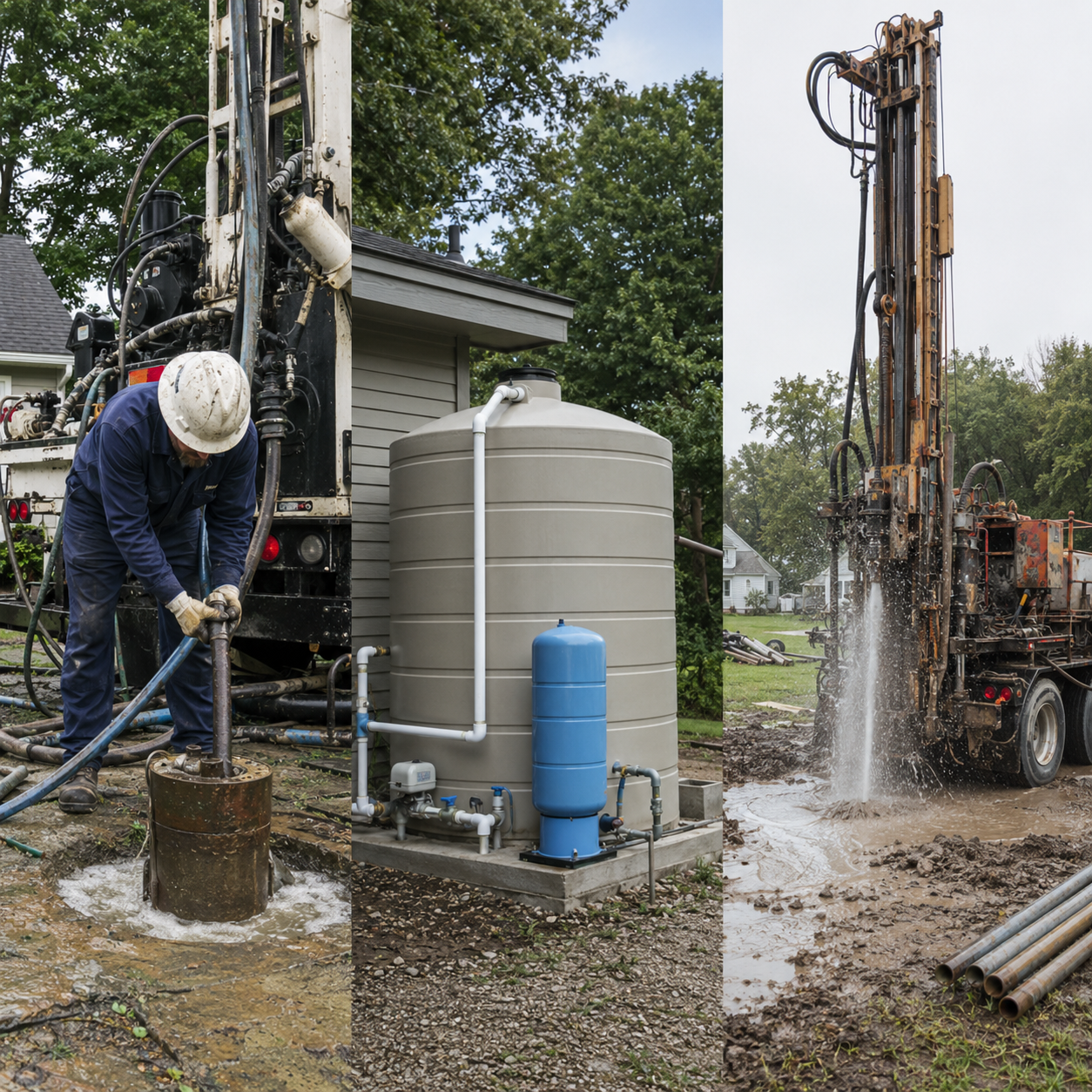
When a private well begins producing less water, homeowners are often presented with several very different solutions. One contractor may recommend rehabilitating the existing well. Another may suggest installing a water storage system. Someone else may advise drilling deeper or starting over with a completely new well.
Each of these approaches can be appropriate under the right circumstances, but they solve different problems. Well rehabilitation attempts to restore performance that has been lost because of conditions inside the well. Storage systems manage a well that continues to produce water but cannot keep up with household demand in real time. New drilling replaces or supplements a well when the existing source is no longer structurally sound, dependable, or capable of meeting the property’s long-term needs.
The most important step is therefore not choosing the most aggressive solution. It is determining why the well is underperforming. A well affected by mineral buildup may respond well to rehabilitation, while a naturally low-producing well may show little lasting improvement from cleaning. Likewise, drilling a new well may be unnecessary when the existing well still produces an adequate daily volume that simply needs to be collected and stored.
Understanding these differences can prevent homeowners from spending thousands of dollars on a treatment that does not address the actual problem.
What Is Well Rehabilitation?
Well rehabilitation is the process of restoring the performance of an existing water well. Over time, minerals, sediment, iron bacteria, biological growth, and other materials can accumulate around the well screen, casing, pump, or surrounding formation. These deposits may restrict the movement of groundwater into the well and cause a gradual decline in production.
Depending on the construction and condition of the well, rehabilitation may include mechanical cleaning, high-pressure jetting, surging, brushing, chemical treatment, disinfection, sediment removal, or redevelopment of the surrounding formation. The goal is generally to remove obstructions and reopen pathways that once allowed water to enter more freely.
Rehabilitation is most promising when a well previously produced considerably more water than it does today. If a well supplied a home successfully for many years and then began declining, there may be a correctable restriction or equipment problem. By contrast, a well that has always produced only a small amount of water may simply be located in a limited aquifer. Cleaning the well cannot create groundwater that the surrounding formation does not contain.
That distinction is central to understanding the role of well rehabilitation in restoring yield. Rehabilitation can restore lost performance in the right situation, but it should not be confused with a guaranteed way to increase the natural capacity of an aquifer.
When Well Rehabilitation Is the Best First Step
Well rehabilitation is often worth considering when there is evidence that the well’s original performance has been reduced by a blockage, buildup, or mechanical issue. A professional evaluation should include a review of the well’s history, current flow rate, static water level, pumping water level, pump condition, water quality, and construction records when available.
Several conditions make rehabilitation a reasonable first option.
The Well Used to Produce More Water
A measurable decline from the well’s historical output is one of the strongest reasons to investigate rehabilitation. If a well once produced eight gallons per minute and now produces only two, something may be restricting groundwater flow or reducing pumping efficiency.
The decline should be confirmed rather than based only on household pressure. A clogged filter, damaged pressure tank, worn pump, leaking pipe, or improperly adjusted pressure switch can resemble a declining well. Testing the well and the delivery system separately helps identify whether the problem is underground or somewhere else in the plumbing.
When a true declining well yield has been documented, rehabilitation may restore some or all of the lost capacity if the cause is treatable.
Mineral Deposits Are Restricting Water Flow
Groundwater naturally carries dissolved minerals. As water moves through the well and pressure conditions change, minerals can precipitate and accumulate on the well screen, casing openings, pump, and surrounding formation. Iron, manganese, calcium carbonate, and other deposits may gradually reduce the open area through which groundwater enters.
A well affected by mineral encrustation may show a gradual decline rather than a sudden failure. Water quality changes, visible scale, iron staining, or increased sediment can provide additional clues. Mechanical or chemical rehabilitation may dissolve or remove these deposits and improve groundwater movement.
The treatment method should be chosen for the well’s construction and the type of buildup present. Applying chemicals without understanding the cause can produce disappointing results and may create disposal or water-quality concerns.
Biological Growth Is Affecting the Well
Iron bacteria and other microorganisms can create slime, staining, odors, and deposits inside a well system. Although these organisms are not always a health threat, the material they produce can restrict flow, foul equipment, and contribute to recurring water-quality problems.
Disinfection alone may temporarily reduce bacterial activity, but a heavily affected well may require physical cleaning and redevelopment before disinfection. Rehabilitation is more likely to provide meaningful improvement when the biological material is removed rather than merely treated at the surface.
Recurring contamination can also indicate a casing defect, poor well cap, surface-water intrusion, or another structural issue. In that situation, cleaning without correcting the entry point is unlikely to provide a lasting solution.
Sediment Has Accumulated Inside the Well
Sand, silt, and sediment may accumulate at the bottom of a well or enter through damaged screens and openings. Excessive sediment can reduce the effective depth of the well, interfere with the pump, damage plumbing fixtures, and make water cloudy after pumping.
Removing accumulated sediment may improve usable well volume and reduce wear on the pump. However, the source of the sediment must also be identified. If the casing or screen is damaged, cleaning the well without completing structural repairs may offer only temporary relief.
The Pump or Well Components Are Not Operating Correctly
Not every loss of water is caused by the aquifer. A worn pump may no longer move water efficiently. A check valve may be failing. A drop pipe may have developed a leak. Electrical problems may prevent the pump from operating at full capacity.
Before paying for rehabilitation or drilling, the system should be inspected for mechanical problems. Replacing a failing pump or repairing a leak may restore performance without altering the well itself. This is also why installing a larger pump without testing the well is risky. A larger pump can draw water down faster and worsen shortages if groundwater production is the real limitation.
When Rehabilitation Is Unlikely to Solve the Problem
Well rehabilitation is not the right answer for every low-yield well. Homeowners should be cautious when rehabilitation is presented as a way to create substantially more groundwater without evidence of clogging or lost performance.
The Well Has Always Been Low Producing
If a well has produced half a gallon or one gallon per minute since it was drilled, that rate may reflect the natural capacity of the surrounding formation. Rehabilitation may clean the well, but it is unlikely to transform a naturally limited source into a high-producing one.
A low flow rate does not necessarily make the well unusable. One gallon per minute can produce approximately 1,440 gallons over a full day if the water is collected continuously. The difficulty is that household demand occurs in short bursts, while the well produces slowly.
In this situation, the homeowner may benefit more from a properly designed well water storage system than from repeated attempts to increase the well’s natural yield.
Water Levels Recover Slowly Because of the Aquifer
A pump test can help distinguish between a clogged well and a limited aquifer. If the water level drops during pumping and then recovers very slowly, the surrounding formation may simply transmit groundwater at a low rate.
Rehabilitation may still be considered if the well previously recovered faster, but a naturally slow recovery pattern usually calls for management rather than restoration. The system needs to draw water at a sustainable rate, allow the well to recover, and store the water until it is needed.
Seasonal Drought Is Reducing Available Groundwater
A well may perform well during wet months and struggle late in the summer. This pattern often reflects seasonal changes in groundwater levels rather than a physical obstruction inside the well.
Cleaning the well cannot restore water that is temporarily unavailable in the aquifer. In drought-prone areas, homeowners generally need a strategy that accounts for seasonal production changes. Increasing storage, reducing peak demand, and protecting the pump from excessive drawdown may offer more value than rehabilitation alone.
The Aquifer Has Declined Over Time
Regional groundwater changes can reduce the yield of many wells in the same area. Increased development, drought, heavy pumping, or long-term changes in recharge may lower the water table or reduce available flow.
If neighboring wells are experiencing similar declines, the problem may extend beyond the individual well. Rehabilitation cannot reverse regional aquifer depletion. The homeowner may need to consider storage, modifications to the existing well, a deeper well, or a new water source.
The Well Has Major Structural Damage
Collapsed casing, severe corrosion, failed screens, unstable formations, and significant surface-water intrusion may make rehabilitation impractical or unsafe. Some structural problems can be repaired, but the cost and expected life of the repair should be compared with the cost of replacement.
A camera inspection can be useful when structural damage is suspected. If the well is very old and has several major deficiencies, putting more money into rehabilitation may delay an inevitable replacement without providing dependable long-term service.
When Storage Is Better Than Rehabilitation
Storage is usually the stronger choice when the well is still producing useful water but cannot meet peak household demand. Instead of trying to increase the flow coming from the ground, storage captures the water the well already produces and makes it available when the home needs it.
This approach is especially effective when testing shows that the well produces enough total water over a day but not enough gallons per minute to support showers, laundry, irrigation, and other uses occurring close together. The mismatch is between production and timing, not necessarily between production and total consumption.
A well producing one gallon per minute could theoretically provide more than enough water for many households over 24 hours. Without storage, however, it may run out during a 20-minute period of heavy use. Atmospheric storage creates a reserve that separates slow well production from higher household flow.
This is one reason storage often performs better than attempting to rehabilitate a naturally low-producing well. Rehabilitation tries to restore lost capacity. Storage makes better use of the capacity that already exists.
Homeowners comparing these approaches should understand that a traditional pressure tank is not the same as a high-capacity atmospheric tank. A pressure tank primarily limits pump cycling and helps regulate pressure. It does not usually provide the hundreds of gallons of usable reserve needed to compensate for a truly low-producing well. The difference between atmospheric and bladder storage tanks becomes especially important when the well produces only a few gallons per minute or less.
When the Well Harvester® Is the More Practical Solution

The Well Harvester® is designed for wells that continue to produce water but need intelligent management to become reliable. Rather than attempting to force additional production through repeated rehabilitation, the system collects water at a rate the well can sustain and stores it for later use.
This allows the well to produce gradually throughout the day and night. When several fixtures are used at once, the home receives water from the stored reserve through a booster pump rather than depending directly on the well’s instantaneous flow.
The Well Harvester also helps protect the well from over-pumping. This is an important difference between a complete low-yield well management system and a tank controlled only by a timer or basic float switch. The objective is not simply to fill a tank. It is to collect available water without repeatedly drawing the well below a safe operating level.
For a well that has always had limited production, or one whose output cannot be restored economically, this approach may provide a more predictable result than rehabilitation. It can also avoid the uncertainty of drilling another well when the existing source still produces enough daily water to meet the property’s needs.
The right choice still depends on testing. If mineral buildup has reduced a well from six gallons per minute to one, rehabilitation may be worthwhile before installing storage. If the well is clean and structurally sound but naturally produces one gallon per minute, storage and intelligent management are usually addressing the actual problem.
When New Drilling Makes More Sense
Drilling a new well should generally be considered when the existing well cannot be restored safely or economically, does not produce enough total water even with storage, or is no longer suitable as a dependable water source.
The Existing Well Is Structurally Unsound
A badly damaged casing, collapsed borehole, failed screen, or persistent pathway for surface contamination may make replacement more practical than rehabilitation. Repairs may be technically possible, but the expected service life and risk of recurring problems should be considered.
The Well Produces Too Little Total Water
Storage can solve a timing problem, but it cannot solve a total supply problem. If the well produces less water over 24 hours than the household regularly consumes, increasing storage alone will eventually result in an empty tank.
The homeowner should compare measured daily well production with realistic household demand. If the gap is too large, drilling deeper, hydrofracking where appropriate, adding a second well, reducing demand, or developing another source may be necessary.
Water Quality Problems Cannot Be Corrected Reliably
Some water-quality issues can be treated with filtration, disinfection, or rehabilitation. Others may come from the aquifer itself or from an unrepairable construction defect. Persistent contamination that returns after proper treatment may justify replacing the well and locating the new source farther from contamination risks.
Rehabilitation Has Already Failed
When a properly performed rehabilitation produces little improvement or the gains disappear quickly, repeating the same process may not be a wise investment. The well may be limited by geology, extensive structural deterioration, or regional groundwater conditions.
At this point, the homeowner should compare storage and replacement rather than continuing to pay for short-lived treatments.
The Property’s Needs Have Changed
A well that once supplied a small household may no longer be adequate after the addition of bedrooms, livestock, irrigation, accessory dwellings, or other water demands. Even if the well has not declined, the property may have outgrown it.
Storage can absorb peak demand and often postpones or eliminates the need for a new well. However, when total daily consumption consistently exceeds production, new drilling may be the more appropriate long-term investment.
Because drilling involves substantial cost and uncertain underground conditions, homeowners should understand what to expect when drilling a new well before assuming replacement will guarantee better production.
A Practical Decision-Making Process
Choosing among rehabilitation, storage, and drilling should begin with objective testing rather than assumptions. A qualified professional may measure the static water level, pumping water level, recovery rate, flow rate, water quality, pump performance, and well depth. Historical drilling records and previous test results can make the evaluation more useful.
Once that information is available, the decision becomes clearer.
Choose rehabilitation when the well has lost production because of mineral deposits, biological growth, sediment, mechanical problems, or another correctable restriction. The best candidates are wells with a documented history of stronger performance and no major structural failure.
Choose storage when the well is structurally sound and produces enough total water, but does so more slowly than the household uses it. This is common with low-yield wells that struggle during peak demand but recover when given enough time.
Choose new drilling when the existing well is badly damaged, persistently contaminated, incapable of meeting total daily demand, or unlikely to provide dependable service even after rehabilitation and storage.
Some properties may benefit from combining solutions. A well with mineral buildup might first be rehabilitated to recover available production and then connected to storage so it is no longer over-pumped. This combination addresses both the lost efficiency of the well and the mismatch between production and household demand.
Avoid Choosing a Solution Based Only on Upfront Cost
The least expensive option today is not always the most economical solution over the life of the water system. A low-cost rehabilitation that must be repeated every few years can eventually cost more than storage. A basic tank system that does not protect the well may create new pump problems. A new well that produces no more water than the old one can become an especially expensive disappointment.
Homeowners should compare expected results, uncertainty, maintenance, system life, and the consequences of failure. It is also important to consider how disruptive each option will be. Rehabilitation may temporarily take the well out of service. Storage requires space and installation work. Drilling can involve permits, access for heavy equipment, trenching, electrical work, and restoration of the property.
A broad comparison of low-yield well solutions can help homeowners avoid treating every water shortage as the same problem.
The Bottom Line
Well rehabilitation is most valuable when a well has lost performance that can realistically be restored. Mineral buildup, bacterial fouling, sediment accumulation, and certain mechanical problems can restrict a well that once produced more water. When these conditions are confirmed, rehabilitation may extend the life of the well and delay the need for replacement.
Storage is usually the better solution when the well is not damaged but naturally produces water more slowly than the household uses it. By collecting water over time, a storage system can turn a low flow rate into a dependable reserve without trying to change the aquifer.
New drilling becomes the stronger choice when the existing well is structurally compromised, persistently contaminated, unable to produce enough total water, or no longer worth repairing. Even then, drilling should be approached with realistic expectations because a new location does not guarantee a higher yield.
The right solution starts with identifying the real limitation. Rehabilitation restores lost performance. Storage manages limited production. Drilling develops a new source. Once homeowners understand which problem they actually have, they can invest in the option most likely to provide reliable water for years to come.