Low-Yield Well Recovery: Natural Recharge Strategies That Work
If you own a low-yield well, you’ve probably experienced the frustration of watching water availability fluctuate throughout the year. Maybe your water pressure drops during periods of heavy use. Perhaps the well struggles to keep up when family members are showering, laundry is running, and irrigation systems are active at the same time. In some cases, homeowners find themselves carefully planning water usage around the limitations of their well rather than using water whenever they need it.
The good news is that a low-yield well doesn’t necessarily mean you’re running out of water. In many situations, the well is still producing a sufficient amount of water over time—it simply can’t replenish itself as quickly as the household is consuming it. Understanding this distinction is one of the most important steps toward improving reliability and reducing water shortages.
Many homeowners immediately begin looking for ways to increase well yield, deepen the well, or drill a new one. While those options may be appropriate in certain circumstances, they aren’t always necessary. Often, the most effective strategy is learning how to support the well’s natural recovery process and building a water system that works with the aquifer rather than against it.
By understanding how groundwater recharge works and implementing a few proven strategies, many property owners can significantly improve the performance of a low-producing well while avoiding unnecessary stress on pumps, plumbing, and other system components.
Why Some Wells Recover Slowly
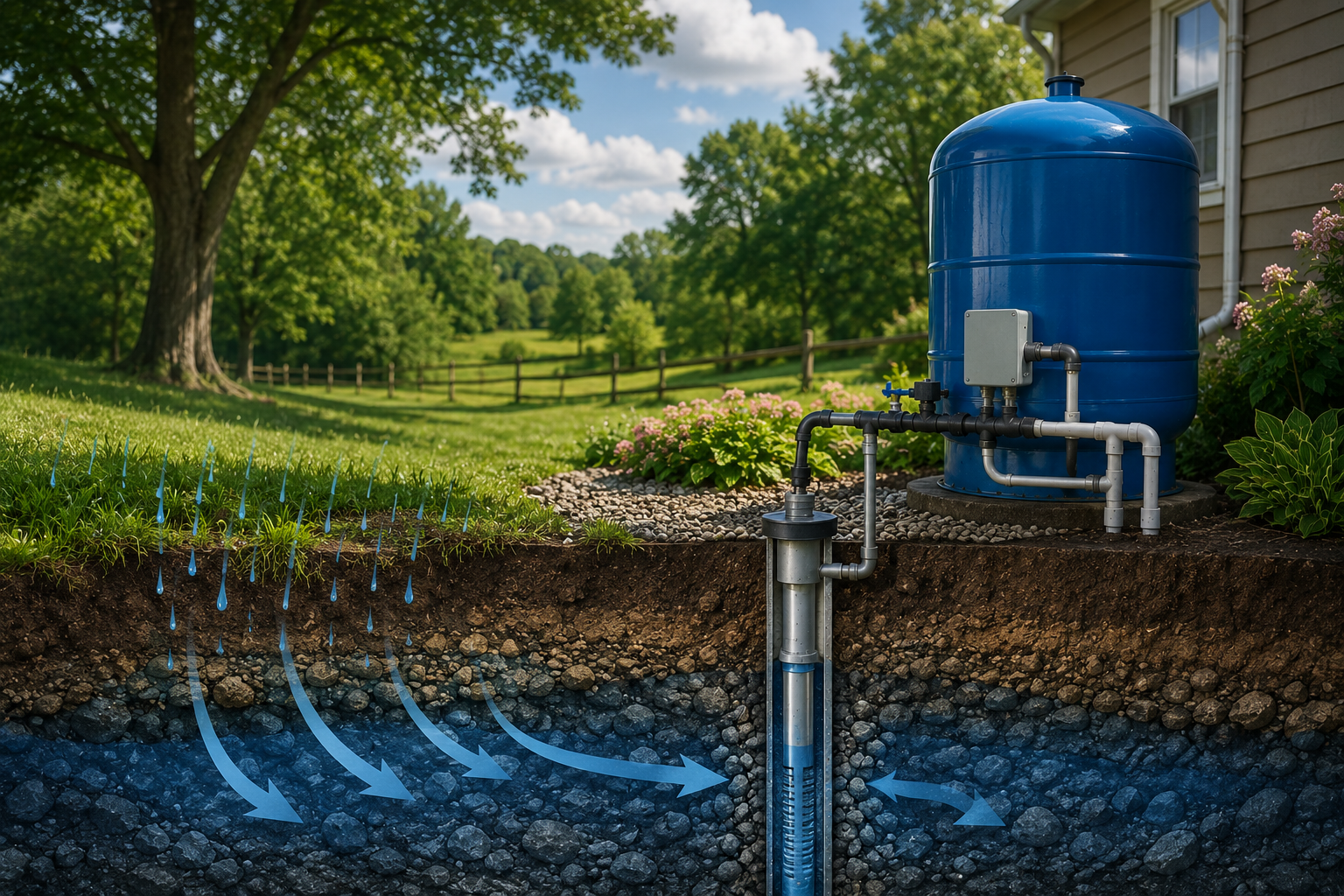
Every well depends on groundwater movement. Contrary to what many people imagine, most wells are not drawing from large underground lakes. Instead, they pull water from fractures in bedrock, porous soils, gravel formations, and other geological structures that slowly transmit groundwater through the earth.
The speed at which water moves toward a well varies dramatically depending on local geology. Some wells recover quickly because they are connected to highly productive aquifers. Others may only receive a slow trickle of water throughout the day. When water is removed faster than it can be replaced, the water level inside the well begins to drop.
This is why many homeowners with low-yield wells notice problems during peak demand rather than experiencing a complete lack of water all the time. The well may produce enough water over a 24-hour period, but it struggles to deliver that water fast enough during periods of concentrated use.
Understanding how a well’s recovery rate affects daily water availability can help homeowners avoid many of the mistakes that lead to recurring shortages. In fact, one of the most common misconceptions is that low production automatically means the well is failing. In many cases, the issue is simply that water demand and well recovery are out of balance.
Recovery Starts With Reducing Stress on the Well
When homeowners experience water shortages, the instinct is often to find ways to extract more water from the ground. However, improving low-yield well recovery is frequently less about increasing production and more about reducing stress.
Think of a low-yield well like a savings account. If withdrawals happen faster than deposits, the balance drops. The same principle applies underground. When the well is repeatedly pumped faster than the aquifer can replenish it, water levels decline and recovery times increase.
This is especially common during the summer months when water use typically rises. Irrigation, gardening, livestock watering, recreational activities, and higher household consumption can all increase demand precisely when groundwater recharge is often at its lowest.
Allowing the well more time to recover between periods of heavy use can dramatically improve reliability. While this may sound simple, many homeowners underestimate how much water is consumed during a typical day. A few showers, a load of laundry, dishwasher use, and lawn irrigation can quickly place significant demand on a low-producing well.
Understanding Peak Demand vs. Daily Production
One of the biggest challenges for homeowners with low-yield wells is that water shortages often have very little to do with total daily production.
A well that produces just one gallon per minute may seem inadequate at first glance. However, over the course of a full day, that same well can generate more than 1,400 gallons of water. For many households, that’s more than enough to meet daily needs.
The real issue is timing.
Most families use water in concentrated bursts. Mornings are particularly demanding, with showers, toilets, sinks, coffee makers, and appliances all competing for water simultaneously. Evenings often create another spike in usage.
When demand exceeds the well’s recovery rate, shortages occur. When demand is spread out more evenly, many low-yield wells perform surprisingly well.
This is why some homeowners discover that simple changes to water usage patterns can provide noticeable improvements without any modifications to the well itself. The goal is not necessarily to use less water overall but to avoid drawing large amounts of water faster than the aquifer can replace it.
Improving Groundwater Recharge on Your Property
While homeowners cannot control regional groundwater conditions, they can often improve how water moves through their own property.
Rainfall and snowmelt play an important role in groundwater recharge. Unfortunately, many modern properties are designed to move water away as quickly as possible. Large driveways, compacted soils, patios, and drainage systems can reduce infiltration and increase runoff.
Over time, encouraging more water to soak into the ground can support healthier groundwater conditions.
Property owners may benefit from practices such as:
Reducing soil compaction
Maintaining healthy vegetation
Installing rain gardens
Improving drainage patterns
Preserving permeable surfaces
Directing runoff toward infiltration areas
While these strategies won’t instantly increase well production, they can contribute to better long-term groundwater health and support local aquifer recharge.
For rural properties, small farms, and homesteads, these practices often provide benefits beyond well performance, including erosion control, healthier soils, and improved water management across the property.
Why Over-Pumping Can Make Recovery Worse
One of the fastest ways to create ongoing well problems is to repeatedly over-pump the system.
When a low-yield well is forced to produce water faster than its natural recharge rate, the water level drops significantly. If this happens frequently, the pump may operate under increasingly stressful conditions. In extreme cases, homeowners may experience dry-running events, sediment issues, declining pressure, or premature equipment failure.
Many people assume that installing a larger pump will solve water shortages. Unfortunately, a bigger pump often removes water faster rather than increasing the amount of water available underground.
The result is similar to drinking through a larger straw. The container empties more quickly, but it doesn’t hold any additional water.
Protecting the well from excessive drawdown is one of the most effective recovery strategies available. By allowing groundwater levels to stabilize and replenish naturally, homeowners can often improve long-term reliability while reducing wear on expensive equipment.
The Role of Water Storage in Well Recovery
When discussing natural recharge strategies, few solutions are as effective as water storage.
Storage works because it separates water production from water consumption. Instead of requiring the well to instantly meet household demand, water can be collected gradually over time and stored for later use.
This approach is particularly valuable for low-producing wells because it allows the aquifer to recharge naturally while still providing the household with dependable water availability.
Imagine a well that produces only a small amount of water each minute. On its own, that production rate may struggle to support multiple showers, laundry loads, and household activities occurring simultaneously. However, when that water is stored throughout the day and night, it becomes available whenever the home needs it.
This simple concept is why so many successful low-yield well solutions incorporate storage as a core component. Rather than fighting the well’s limitations, storage allows homeowners to work within them.
Many homeowners are surprised by how dramatically reliability improves once they stop relying exclusively on real-time well production.
Seasonal Changes and Recovery Rates
Another factor that affects well recovery is seasonality.
Groundwater conditions often change throughout the year. During wetter months, aquifers may receive significant recharge from rainfall and snowmelt. During droughts or extended dry periods, recharge slows and water levels can decline.
This is why many homeowners notice that their well performs differently depending on the season.
A well that easily meets demand during spring may struggle during late summer. Likewise, a property that has experienced several years of below-average precipitation may notice gradual changes in well performance.
While seasonal fluctuations are normal, they can create challenges for homeowners who rely on a low-producing well. Building resilience into the water system becomes increasingly important as weather patterns become more unpredictable.
Planning for dry periods before they arrive is often much easier and less expensive than scrambling for solutions during a water shortage.
Why Drilling a New Well Isn’t Always Necessary
When low-yield well problems persist, many homeowners begin researching new wells. While drilling can be appropriate in certain situations, it’s important to remember that a new well is not guaranteed to produce more water.
Groundwater conditions vary significantly even across relatively small areas. Two neighboring wells may have dramatically different production rates despite being only a short distance apart.
Drilling also involves substantial costs, permitting requirements, and uncertainty. Depending on local geology, there is always the possibility that a new well may not deliver the results homeowners are hoping for.
Before pursuing a replacement well, it often makes sense to evaluate whether the existing well can be managed more effectively. In many cases, improving storage capacity, protecting the well from over-pumping, and supporting natural recharge can provide substantial improvements without the expense of drilling.
Working With Nature Instead of Against It

The most successful low-yield well recovery strategies share one common characteristic: they work with the well’s natural production rate rather than attempting to force more water from the aquifer.
This is where many homeowners see the greatest improvement.
Instead of constantly monitoring water use, worrying about recovery times, or trying to guess how much water remains available, the focus shifts toward creating a system that respects the well’s limitations while maximizing its strengths.
For many properties, this means allowing water to accumulate gradually and using it when needed rather than demanding immediate production from the well itself.
This philosophy forms the foundation of systems like the Well Harvester®, which are designed specifically for low-producing wells. By collecting water as the well naturally recovers and storing it for future use, the system helps homeowners take advantage of every gallon their well produces while reducing the risk of over-pumping.
Rather than treating low yield as a problem to overcome, it treats low yield as a condition to manage intelligently.
Signs Your Well Could Benefit From Recovery-Focused Solutions
Many homeowners wait until they experience a complete water outage before exploring solutions. However, several warning signs often appear long before the situation becomes critical.
These may include:
Reduced water pressure during heavy use
Long recovery periods after showers or laundry
Seasonal water shortages
Air sputtering from faucets
Increasing pump run times
Frequent cycling of pressure equipment
Water restrictions becoming part of daily life
If these symptoms sound familiar, your well may already be telling you that demand is exceeding recovery.
Addressing the issue early often provides more options and lower costs than waiting for a major failure to occur.
Building Long-Term Reliability
Low-yield wells don’t have to control how you use water.
While every property is different, many homeowners discover that improving reliability has less to do with increasing production and more to do with improving management. By understanding how groundwater recharge works, reducing unnecessary stress on the well, encouraging natural recovery, and utilizing storage effectively, it is often possible to transform an unreliable water supply into a dependable one.
The most successful solutions recognize a simple truth: water cannot be forced into an aquifer faster than nature allows. However, it can be collected, stored, and managed in ways that make the most of every gallon available.
For homeowners dealing with slow recovery rates, seasonal shortages, or declining well performance, supporting natural recharge is often one of the smartest long-term investments they can make. When the well is allowed to recover at its own pace, the results are frequently more sustainable, more reliable, and far less expensive than constantly chasing short-term fixes.