How to Size a Water Storage Tank for a Family of 4 (or More)
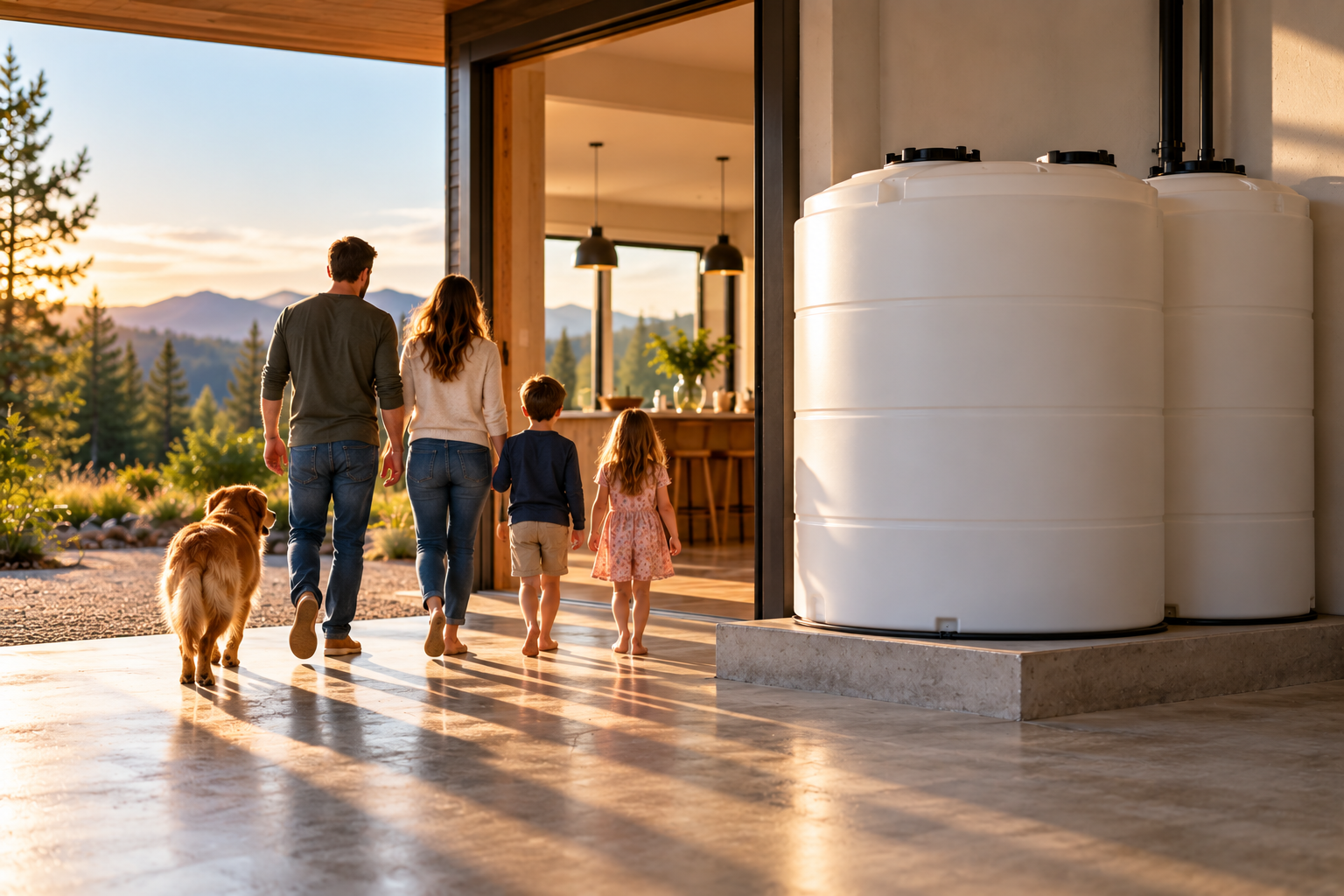
If your home relies on a private well, choosing the right water storage tank size can make the difference between constantly worrying about running out of water and having a dependable supply available when you need it.
For a family of four, a good starting point is to plan for roughly 320–400 gallons of household water use per day. Larger families may use considerably more. But that does not necessarily mean a family of four needs a 400-gallon water storage tank.
That is one of the most important things to understand about sizing well water storage.
Your storage tank does not always need to hold an entire day’s water supply at once. In many homes, the well continues producing water throughout the day and refilling the tank between periods of higher demand. The tank acts as a buffer between the relatively slow production of the well and the much faster rate at which your family may use water.
That means the correct tank size depends on more than household size. You also need to consider your well’s production rate, how quickly it recovers, when your family uses the most water, whether you irrigate outdoors, and how much reserve capacity you want.
Let’s break it down.
How Much Water Does a Family of Four Use?
A practical planning estimate for residential water use is around 80–100 gallons per person per day. Actual usage can be significantly lower or higher depending on your home, fixtures, appliances, habits, and outdoor water use.
For a family of four, that puts typical planning demand around 320–400 gallons per day.
A family of five might plan around 400–500 gallons per day, while a six-person household could approach 480–600 gallons per day.
That sounds like a lot of water, but it is important to remember that your family does not use all of it at once.
Water use happens in bursts.
You may use very little water overnight. Then suddenly two people take showers while a toilet flushes and the washing machine fills. Later in the day, almost no water may be used for several hours. In the evening, demand increases again as people shower, cook, run the dishwasher, do laundry, and use other fixtures.
This is why simply multiplying the number of people in the home by 100 gallons and buying a tank that large is not always the best way to size a water storage system.
Daily Water Use and Peak Water Demand Are Different
Suppose a family of four uses 350 gallons in an average day.
Their well produces 0.5 gallons per minute.
At 0.5 GPM, the well theoretically produces 30 gallons per hour, or as much as 720 gallons over 24 hours if water were available at that rate continuously.
On paper, that well produces more than enough water for a family using 350 gallons per day.
So why could they still run out of water?
Because the house might need 10, 12, or even 15 gallons per minute for short periods of time while the well replenishes at only 0.5 GPM.
The problem isn't necessarily the total amount of water available over the course of a day. It is the enormous difference between when the well produces water and when the house needs it.
Water storage solves that problem.
Instead of requiring the well to produce 10 GPM while multiple fixtures are running, the well can gradually fill a storage tank at a much slower rate. When the home suddenly needs a large amount of water, a separate booster pump draws from that stored supply.
The well produces slowly.
The tank stores that production.
The home uses it quickly when needed.
That simple concept is what allows even some very low-producing wells to support normal household water use.
Start With Your Household’s Actual Water Demand
Before choosing a tank, think about how your family actually uses water.
A four-person household with efficient fixtures, no irrigation, and fairly conservative habits may use considerably less water than another family of four with teenagers, frequent laundry, large bathtubs, irrigation, and overnight guests.
If you already have a water meter or another way to track household consumption, real usage data is better than any general estimate.
If you do not, using 80–100 gallons per person per day provides a reasonable planning range.
For a four-person household, we would normally begin the conversation around 320–400 gallons per day and then look at what could push that number higher.
Large soaking tubs, long showers, frequent laundry, water treatment equipment that backwashes, irrigation, livestock, workshops, guest houses, and additional occupants can all substantially increase demand.
You should also think about the future. If you are sizing a water storage system for a family of four today but expect your household to grow, leaving room to expand can make more sense than designing the system around your absolute minimum requirements.
Next, Determine How Much Water Your Well Can Produce
Household demand is only half of the equation.
The other half is your well.
Well production is normally expressed in gallons per minute, or GPM. A well producing 5 GPM can replenish water ten times faster than a well producing 0.5 GPM.
Even very small numbers add up when given enough time.
A 1 GPM well corresponds to as much as 60 gallons per hour and 1,440 gallons over 24 hours. A 0.5 GPM well corresponds to 30 gallons per hour and 720 gallons over 24 hours. A 0.25 GPM well corresponds to 15 gallons per hour and 360 gallons over 24 hours.
Those numbers are useful for understanding the potential water available over time, but they should not be mistaken for a guarantee that a well can be pumped continuously at that rate. Actual well production and recovery can change as water levels drop, seasons change, and groundwater conditions fluctuate.
That is why a proper evaluation of a low-yield well should consider sustainable production and recovery rather than simply looking at how quickly water comes out of a faucet.
A well that was measured at 1 GPM years ago may not necessarily be producing 1 GPM today.
The Tank Needs to Cover the Gap
The easiest way to understand storage sizing is to think about the tank as covering a gap.
Imagine a family uses 100 gallons of water during a busy two-hour morning period.
A 0.5 GPM well can theoretically replenish about 60 gallons during those same two hours.
That leaves roughly a 40-gallon difference.
In a perfect mathematical world, 40 gallons of stored water would cover the shortage.
But you would not normally size the tank that tightly. Water use varies from day to day, well production can change, and you do not want normal household demand constantly bringing your storage down to the minimum level.
That is why a larger reserve is generally desirable.
Now consider a household that uses 150 gallons during a heavy morning or evening period while its well produces only 0.25 GPM. During three hours, the well may contribute only about 45 gallons. Storage has to supply the rest.
The slower the well and the more concentrated the household demand, the more valuable additional storage becomes.
Does a Family of Four Need a 400-Gallon Tank?
Not necessarily.
This is one of the most common misunderstandings when homeowners begin researching well water storage tanks.
If your family uses 400 gallons per day, you do not necessarily need to have 400 gallons sitting in storage every morning.
Consider a 215-gallon storage tank. If the family uses 75 gallons during the morning, the well can begin replenishing that water as soon as tank capacity becomes available. By the time another high-demand period arrives later in the day, much of that water may have already been replaced.
The same stored water capacity can effectively be used multiple times in a day as the tank fills, water is used, and the tank fills again.
This is why tank turnover and well recovery matter just as much as raw tank capacity.
A 215-gallon tank with a well that reliably replenishes it throughout the day may provide better real-world performance than a much larger tank connected to a source that simply cannot produce enough water.
Storage changes when water is available. It does not create additional groundwater.
What About a Very Low-Producing Well?
Tank sizing becomes more important as the well gets slower.
Consider a family of four using approximately 350 gallons per day with a well capable of sustaining around 0.25 GPM.
At 0.25 GPM, the theoretical 24-hour production is 360 gallons.
Now there is very little margin between household consumption and available production.
A larger storage tank may help the family get through periods of heavy use, but simply installing a 1,000-gallon tank does not solve the underlying water balance. Once the tank is depleted, the well still has to replace that water.
For extremely low-yield wells, household usage may need to be evaluated alongside well production to determine whether the source itself can meet the household's long-term needs.
Storage is extremely effective at solving a timing problem. It cannot permanently solve a situation where the household consumes substantially more water than the well can replenish.
This distinction is important when deciding whether to add more storage.
A Practical Tank Size for a Family of Four
For many four-person households dealing with a low-yield well, storage in the 200–500 gallon range can provide a useful buffer between well production and household demand.
Where you fall within that range depends heavily on your well.
If the well produces enough water over the course of the day and the primary problem is keeping up during showers, laundry, and other short periods of heavy use, storage toward the lower end of that range may be sufficient.
If the well is extremely slow, production fluctuates, the household frequently has guests, or water usage happens in larger bursts, additional storage provides more operating reserve.
Some families may prefer 500 gallons or more simply because they want a substantial cushion.
Others may operate very comfortably with a smaller tank because their well is continuously replenishing the water that was used.
There is no single tank size that is correct for every family of four.
What Changes With a Family of Five, Six, or More?
As household size increases, both total daily consumption and peak demand tend to increase.
A family of six may use around 480–600 gallons per day. But again, that does not automatically mean the home needs a 600-gallon storage tank.
What matters is whether storage can recover between high-demand periods.
For example, a 1 GPM well may theoretically replenish 240 gallons during a four-hour low-use period. A 0.25 GPM well replenishes only about 60 gallons during that same time.
That difference can completely change the amount of storage required for two otherwise identical six-person households.
Larger households also tend to have more overlapping water demand. Multiple showers, toilets, sinks, dishwashers, and washing machines may operate at the same time.
As household size grows, it becomes increasingly important to design around both water volume and household flow rate.
Don't Confuse a Pressure Tank With a Water Storage Tank
A pressure tank and a bulk water storage tank serve different purposes.
The pressure tank commonly installed with a residential well is designed primarily to maintain water pressure and reduce short cycling of the well pump. Although the tank may have a label saying 40, 60, or 80 gallons, only a portion of that total volume is normally available as usable water between pump cycles.
An atmospheric water storage tank works differently.
It can store hundreds of gallons of water at atmospheric pressure. A separate booster pump then takes water from storage and pressurizes it for the house.
For a genuinely low-yield well, this distinction is significant.
Adding a larger conventional pressure tank may help reduce pump cycling, but it does not provide the same type of usable reserve as a dedicated bulk storage system.
How Much Emergency Reserve Do You Want?
There is also a difference between sizing a tank for normal operation and sizing a tank for emergency storage.
If your only goal is to bridge peak household demand, the tank may not need to hold an entire day's water use.
If you want a full day of water available even if the well temporarily stops producing, your sizing calculation changes.
A family of four using 350 gallons per day might want approximately 350 gallons of dedicated usable reserve for one day. Two days of reserve pushes that closer to 700 gallons.
However, most people dramatically reduce water consumption during an actual water emergency. A household normally using 350 gallons per day might use much less if everyone knows the stored supply has to last.
You therefore need to decide whether the tank is primarily part of the normal well system or whether you also expect it to function as emergency water storage.
Those are different design goals.
Don't Forget Irrigation and Other Large Water Loads
Outdoor water use can change tank sizing very quickly.
A family may use 350 gallons per day inside the home but then use another 200 gallons watering landscaping. If that irrigation happens during the same period that showers, laundry, and other household fixtures are being used, storage can disappear surprisingly fast.
Whenever possible, large irrigation systems should be evaluated separately from basic household demand.
The same applies to livestock watering, accessory dwelling units, workshops, water treatment backwash cycles, large bathtubs, and other unusual loads.
If your storage tank also needs to provide a code-required reserve or fire-protection supply, those requirements should be calculated separately according to the applicable local rules. Do not assume household storage calculations automatically satisfy fire-storage requirements.
The Well Harvester®: Storage Designed Around the Well

For a low-yield well, choosing the right tank is only part of the problem.
You also need a way to safely collect the water.
That is where the Well Harvester® differs from simply installing a large storage tank and booster pump.
The Well Harvester is designed specifically for low, changing, seasonal, or difficult-to-measure well production. Rather than expecting the homeowner to choose one fixed pumping rate and hope the well continues producing at that rate, the system automatically monitors well operation and manages collection around changing well conditions.
Water is gradually collected from the existing well and stored for later use. If conditions indicate the well is being over-pumped, the system can rest or stop the well pump and allow it to recover before collecting more water.
The household then draws from stored water rather than depending on the well to directly match every shower, appliance, or fixture in real time.
The standard Well Harvester starts with 215 gallons of water storage. Additional 215-gallon storage can be added when a larger reserve is appropriate.
That modular approach can be particularly useful for larger families.
A family of four whose well has adequate daily production may be well served by the standard storage capacity. Another four-person household with a slower or more variable well may benefit from 430 gallons. A larger household, significant irrigation use, or exceptionally long well recovery periods may justify even more storage.
The system also delivers stored water to the home at up to 20 GPM and 60 PSI, so household pressure is no longer limited to the instantaneous production rate of the low-yield well.
That is the key advantage of separating production from consumption.
Your well can produce water at the rate it is capable of producing.
Your family can use water at the rate the home requires.
Storage sits between the two.
And because the Well Harvester manages the well automatically, it is not simply storing water—it is actively helping manage a challenging low-yield water source.
When Should You Add More Storage?
More storage becomes particularly valuable when your existing tank frequently falls to a low level before it has enough time to recover.
For example, if your family routinely empties most of the available storage every morning but the tank is completely replenished several hours later, your storage may already be doing exactly what it is supposed to do.
If the tank is still low when the next high-demand period arrives, adding capacity may provide a meaningful benefit.
This is why tank-level information and actual water-use patterns can be much more useful than simply choosing the largest tank you can fit.
You want enough reserve to comfortably bridge demand while giving the well enough time to replenish that reserve.
Beyond that point, adding gallons may provide additional emergency capacity, but it does not necessarily improve the well’s actual production.
Bigger Isn't Always Better
It is easy to assume that the safest option is simply buying the biggest water storage tank possible.
Sometimes additional storage makes sense. But oversized storage has tradeoffs.
Large tanks require more floor space, cost more to purchase and install, take longer to refill, and may allow water to sit for longer periods in homes with relatively low consumption.
The better goal is not maximum storage.
It is enough storage.
That means enough capacity to handle your family's high-demand periods, allow the well adequate recovery time, provide a reasonable safety margin, and accommodate the way you actually use water.
For one family, that might be approximately 200 gallons.
For another, it could be 500 gallons.
For a large household with a very slow well and significant outdoor water use, it could be considerably more.
Choosing the Right Water Storage Tank Size
If you are sizing a water storage tank for a family of four, start with approximately 320–400 gallons of total daily household use, but don't stop there.
Find out how much water your well can sustainably produce. Look at how quickly it recovers. Think about when your family uses the most water and how long the well has to replenish storage between those periods.
Then size the storage around the difference.
A properly designed storage system allows the well to work gradually while your home continues operating normally. That means no planning showers around laundry, no waiting hours to run the dishwasher, and no expecting a low-producing well to suddenly deliver 10 or 15 gallons per minute.
For families with low-yield wells, that is ultimately the goal: not simply installing a bigger tank, but creating a system that makes the water the well can produce available when the family actually needs it.
If you aren't sure how much storage your household needs, Epp Well Solutions can help evaluate your household size, well production, water-use habits, and history of running out of water to determine the right configuration.
A challenging low-yield well does not always mean you need a new well. In many cases, the real solution is learning to collect water slowly, store it intelligently, and use it when you need it.