
Above-Ground vs. Underground Storage Tanks: Pros, Cons, and Installation Costs in 2026
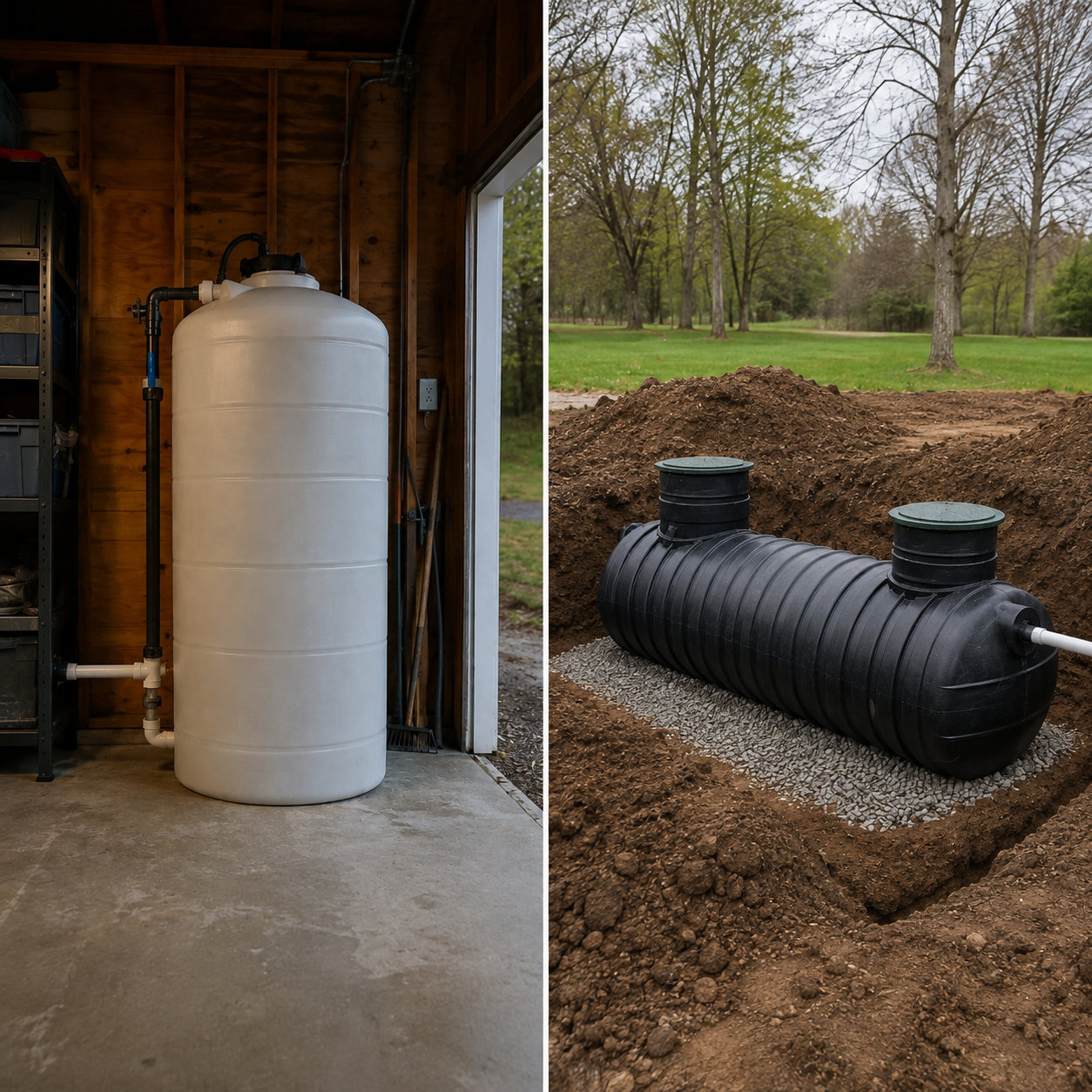
If your well cannot keep up with your household’s water demand, adding storage can completely change the way your water system performs. Instead of expecting your well to produce 10 or 15 gallons per minute every time someone takes a shower, starts the washing machine, or turns on a sprinkler, a well water storage tank allows the well to produce water gradually and save it for later.
But once you decide that water storage makes sense, another question quickly comes up: Should you install an above-ground or underground water storage tank?
Both can solve water-storage problems. Both can work with private wells. And both are available in potable-water-rated materials. However, installation costs, serviceability, freezing concerns, available space, and long-term maintenance can be very different.
For most homeowners, the choice comes down to more than where the tank looks best. An underground system can hide thousands of gallons of water without taking up indoor space, but excavation can make installation significantly more expensive. An above-ground system is usually simpler to install and much easier to service, but it needs an appropriate location and protection from freezing in cold climates.
Here is what homeowners should know about above-ground vs. underground water storage tanks in 2026, including realistic costs, advantages, disadvantages, installation considerations, and where an automated system like the Well Harvester® fits into the equation.
Why Use a Water Storage Tank With a Well?
A storage tank solves a different problem than a traditional well pressure tank.
A pressure tank helps regulate pressure and reduces how frequently your well pump starts and stops. It only contains a relatively small amount of usable water. A water storage tank, cistern, or well reservoir tank is designed to hold a much larger volume of water that can be accumulated over time.
We explain this distinction in more detail in our guide to water pressure tanks vs. storage tanks.
This becomes especially important with a low-yield well.
Imagine that your well consistently produces only one gallon per minute. That may sound inadequate when a household can easily use 10 or more gallons per minute during periods of peak demand. But one gallon per minute represents up to 1,440 gallons over 24 hours if production could continue at that rate.
The problem is not necessarily the total amount of water available. The problem is getting enough of that water at the exact moment you need it.
A properly designed well water storage system can capture the water your well produces during periods of low demand and make that stored supply available during showers, laundry, irrigation, and other high-demand periods.
That is why storage is often worth considering before assuming that an existing well needs to be abandoned or replaced.
Above-Ground vs. Underground Water Storage Tanks at a Glance
FactorAbove-Ground Storage TankUnderground Storage TankInitial costUsually lowerUsually higherExcavationLittle or noneSignificantMaintenance accessExcellentMore difficultLeak detectionEasierMore difficultFreeze protectionRequires planningNaturally better protectedSpace requirementsUses indoor or outdoor spacePreserves usable surface spaceInstallation complexityUsually simplerUsually more complexReplacementRelatively straightforwardRequires excavationBest fitGarages, pump houses, utility rooms, shops, mild climatesLimited indoor space, larger capacities, certain cold-climate installationsTypical 2026 cost directionLowerSignificantly higher
The right choice still depends on your property, climate, storage requirements, well production, plumbing layout, and local regulations.
Advantages of Above-Ground Water Storage Tanks
An above-ground water storage tank is exactly what the name suggests: the tank remains accessible rather than being buried. It might be installed in a garage, basement, utility room, insulated well house, barn, shop, or other protected area. Outdoor installations are also possible with tanks designed for those conditions, particularly in warmer climates.
For well owners, accessibility is one of the biggest advantages.
If a fitting begins leaking, a float needs adjustment, a pump needs replacement, or the tank needs inspection, the equipment can normally be reached without digging anything up. That can make repairs faster and less expensive throughout the life of the system.
Installation is generally easier as well. Rather than excavating an area large enough for a cistern and then properly bedding and backfilling it, many above-ground tanks need little more than a suitable level base, plumbing, electrical work where required, and integration with the rest of the water system.
That simplicity usually translates into a lower total water storage tank installation cost.
Above-ground tanks can also be easier to expand. If your family grows, you begin irrigating more heavily, or the well produces less water during a dry season, an additional tank may sometimes be added without replacing the entire system.
There is also less uncertainty about what is happening around the tank. Underground tank installations have to account for soil pressure, groundwater, drainage, backfill, and sometimes buoyancy. An above-ground tank eliminates many of those concerns.
Tank manufacturers make an important distinction here: a tank manufactured for above-ground use should not simply be buried to save space. Norwesco, for example, specifically states that tanks designed for above-ground installation cannot be buried because surrounding soil loads can collapse the tank walls. Underground applications require a cistern specifically engineered for burial.
Disadvantages of Above-Ground Storage Tanks
The biggest limitation is space.
A large tank has to go somewhere. While modern vertical tanks can store substantial quantities of water within a relatively small footprint, a 500-, 1,000-, or 2,000-gallon conventional tank can take up meaningful space in a garage, building, or yard.
Climate is another consideration.
Water-filled plumbing can freeze, and freeze protection becomes especially important in northern states and higher elevations. Our 2026 guide to water storage tanks recommends locating above-ground systems indoors or in a protected environment where freezing is a concern.
Appearance can matter too. Some homeowners simply do not want a large tank visible beside their home or outbuilding.
An outdoor installation also needs to follow the tank manufacturer’s requirements regarding sunlight, weather exposure, foundations, anchoring, plumbing connections, and operating conditions. Choosing a tank based only on gallon capacity without checking how it is designed to be installed can become an expensive mistake.
Still, when adequate protected space is available, above-ground storage remains one of the most practical approaches to solving a low-producing well.
Advantages of Underground Water Storage Tanks
An underground water storage tank, often called an underground cistern, moves the storage capacity below the surface.
The most obvious advantage is space.
You can potentially store hundreds or thousands of gallons without dedicating a large portion of a garage, shop, or utility room to the tank itself. For properties where indoor square footage is limited or valuable, that can be a major benefit.
Underground installations also offer better natural protection from temperature extremes. The surrounding earth provides insulation, which can make underground storage attractive in regions where prolonged freezing weather complicates above-ground installation.
Larger-capacity systems are another common application. Purpose-built underground cisterns are available in capacities suited to residential, agricultural, rainwater, hauled-water, and low-yield well storage applications. Norwesco, for example, specifically identifies below-ground cisterns as an option when a well cannot meet consumption needs.
There is also the visual advantage. Once installation is finished, relatively little of the system may remain visible above grade beyond access points and associated equipment.
For certain properties, those benefits justify the extra installation work.
Disadvantages of Underground Water Storage Tanks
The biggest disadvantage is cost.
You are no longer paying only for a water tank and plumbing. You may also be paying for excavation equipment, operators, delivery and placement, approved bedding material, backfill, compaction, trenching, access risers, drainage provisions, additional piping, permits, and site restoration.
Soil and groundwater conditions can complicate the project even further.
Below-ground tank manufacturers provide specific requirements for bedding, backfill, groundwater conditions, and installation. Those requirements should not be treated as suggestions. Improper installation can deform a tank, damage fittings, create drainage problems, or void warranties.
Future maintenance is another concern.
An above-ground tank can usually be inspected by simply walking up to it. An underground tank may require access through a riser, and repairing or replacing the tank itself can eventually mean digging again.
Leaks may also be less obvious. A small plumbing problem beside an above-ground system can often be seen immediately. Below grade, identifying the source of a problem can take more work.
That is why underground storage should be viewed as a complete site project rather than simply another style of tank.
Above-Ground and Underground Water Tank Installation Costs in 2026
Prices vary dramatically by tank size, material, region, excavation requirements, pump selection, electrical needs, and existing plumbing. There is no single nationwide price that applies to every well.
However, 2026 market data gives homeowners a useful starting point.
As of August 2026, a 500-gallon above-ground polyethylene water tank was listed at approximately $695 through Home Depot, while a 1,000-gallon Norwesco above-ground polyethylene tank was listed for about $1,700 through Tank Depot. Those are tank-only examples, not complete systems, and retail pricing can change.
The tank itself is only part of the project.
A working household system may also need a booster pump, tank-level controls, float valves, fittings, isolation valves, pressure controls, electrical connections, a foundation or pad, freeze protection, delivery, filtration or treatment equipment, and professional plumbing.
According to Angi's 2026 water-tank cost data, household water tank projects average approximately $1,620 to $3,163 installed, although larger or more complicated cistern systems can cost substantially more. Its broader cistern pricing puts above-ground dry systems around $2,000 to $10,000, while underground cistern installations are listed around $6,500 to $24,000.
Those ranges are useful for planning, but they should not be interpreted as Epp Well Solutions pricing or as guaranteed estimates for a particular well system.
A relatively simple above-ground tank installed next to existing plumbing can fall toward the lower end of the market. A fully automated system with pumps, sophisticated controls, treatment equipment, long plumbing runs, electrical modifications, and extensive site work can cost considerably more.
Underground projects begin with a disadvantage because excavation is unavoidable.
Rocky soil, limited excavator access, high groundwater, unusually deep placement, difficult trench runs, concrete work, engineered anchoring, and removal of excavated material can push costs upward quickly.
For homeowners comparing quotes, it is important to compare the complete installed water system, not just the tank price.
A $1,000 tank that still requires several thousand dollars in separate pumps, controls, plumbing, electrical work, and labor is not actually a $1,000 solution.
What Makes Water Storage Tank Installation More Expensive?
Capacity certainly matters, but gallon size is only part of the equation.
Distance from the well and house can significantly affect plumbing and trenching. A tank installed beside an existing mechanical room is very different from one positioned 150 feet away.
The type of booster pump matters as well. A storage tank generally holds water at atmospheric pressure, which means another pump is normally required to deliver that water throughout the house at useful pressure. The pump needs to be sized for the household’s required flow, elevation, plumbing restrictions, and pressure settings.
Control systems are another major difference between basic tanks and complete water-storage solutions.
A traditional setup may depend on float switches, timers, pump controllers, pressure switches, relays, and other independent components. That can work, but installing and configuring the entire system takes additional labor and technical knowledge.
Treatment can also affect the project. Storage does not automatically purify well water. Depending on the property, sediment filtration, iron or sulfur treatment, ultraviolet disinfection, softening, or other equipment may still be appropriate.
For potable-water applications, tank material should also be chosen carefully. NSF maintains listings for products evaluated under NSF/ANSI/CAN 61, a widely used health-effects standard for components that contact drinking water. Homeowners can review NSF's certified potable-water component listings when evaluating equipment.
The Well Harvester®: More Than an Above-Ground Storage Tank

For a homeowner with a low-yield well, there is another important question to ask:
Do you simply need a tank, or do you need a system that knows how to manage the well?
The Well Harvester® from Epp Well Solutions was designed around that second problem.
Instead of combining a generic storage tank with separate timers, controls, pumps, and monitoring equipment, the Well Harvester integrates automatic well-production management, over-pump protection, water storage, household pressure delivery, and touchscreen monitoring into one coordinated system.
The standard Well Harvester starts with 215 gallons of potable-water storage and can be expanded by adding additional 215-gallon tanks. Its integrated booster system can supply the house at up to 20 gallons per minute and 60 PSI, depending on plumbing and installation conditions.
That distinction matters.
A conventional tank can store water, but it does not automatically know when a low-yield well is approaching the point where pumping should stop. The Well Harvester monitors production behavior and manages the existing well pump to help capture available water without relying solely on a homeowner-adjusted timer.
The touchscreen also gives the homeowner visibility into tank level, pressure, flow, pump activity, system status, production, and water-use information.
And because the standard system uses a narrow vertical design, its footprint is approximately 26 by 43 inches while standing about 73 inches tall. That can make a major difference when floor space is limited.
The Well Harvester is an above-ground system and should be installed on a stable, level surface in a protected location such as a garage, basement, utility room, insulated pump house, or shop. It should be protected from freezing, prolonged sunlight, and direct weather exposure.
It is also important to understand what the system does not do. The Well Harvester cannot create additional groundwater or guarantee how much water an aquifer will produce. Instead, it helps make better use of the water your well can produce by collecting it over time, protecting against over-pumping, storing it, and delivering that stored water to the house at useful pressure.
That makes the Well Harvester especially worth considering when the real problem is not simply “I need a tank,” but rather “My well runs out of water and I need the entire system to manage that problem automatically.”
Homeowners can get a personalized Well Harvester recommendation and quote based on their existing well and household demand.
Above-Ground vs. Underground Tanks in Cold Climates
One of the strongest arguments for underground storage is freeze protection.
However, burying the tank is not the only solution.
An above-ground storage system installed inside an insulated garage, basement, well house, utility building, or other conditioned space can also operate successfully in cold regions. In many cases, this gives homeowners the maintenance advantages of an above-ground system without exposing the equipment to outdoor winter conditions.
If there is no suitable protected space, an underground cistern may become more attractive.
This decision needs to account for the entire system—not just the tank. Pipes, valves, pumps, filters, fittings, and controls may all need protection from freezing.
Before choosing a tank based strictly on climate, compare the cost of creating or using a protected above-ground installation area with the cost of excavation and long-term underground service access.
Sometimes building a small insulated pump house can be more practical than burying thousands of gallons of storage.
Maintenance and Water Quality Matter Too
Private-well owners have additional responsibility for maintaining water quality.
The U.S. Environmental Protection Agency notes that private domestic wells are generally not regulated under the federal Safe Drinking Water Act in the same way that public water systems are. In other words, maintaining and testing the system largely falls to the property owner. You can learn more through the EPA's Private Drinking Water Wells resources.
The CDC also recommends that private well owners regularly maintain their wells and test well water at least annually for appropriate contaminants. Its Well Water Safety guidance is a useful resource for homeowners.
Adding storage does not eliminate those responsibilities.
A potable-water storage system needs appropriate tank materials, covered access, proper venting, correct plumbing, and maintenance. Any filtration or treatment required by the property's water chemistry should still be properly incorporated into the system.
This is another area where accessibility favors above-ground tanks: inspecting components, identifying leaks, and servicing pumps and controls is generally easier when everything can be reached without excavation.
How to Choose Between Above-Ground and Underground Water Storage
Before committing to either installation, consider the complete property rather than just comparing gallon capacity. The most useful questions include:
How many gallons of water does the household actually need during peak demand, and how much does the well reliably produce?
Is there protected space in a garage, basement, shop, pump house, or utility room for an above-ground system?
Does the local climate create significant freeze concerns?
How much reserve water is needed between well recovery periods?
Will irrigation, livestock, rental units, or future household growth increase demand?
Can excavation equipment easily reach the proposed underground tank location?
Are groundwater, drainage, rock, or soil conditions likely to complicate burial?
How important is easy access for future inspection, repairs, and replacement?
Does the system need only storage, or does the well also need automatic low-production management and over-pump protection?
For capacity planning, our guide on how to choose a water storage tank size walks through the relationship between well production, household water use, and storage volume.
Which Type of Water Storage Tank Is Better for a Low-Yield Well?
For many residential low-yield wells, above-ground storage is the simpler and more serviceable option, especially when there is a garage, basement, utility room, well house, or shop available.
You avoid major excavation. Components stay accessible. Expanding storage can be easier. Problems are easier to see. And installation costs are usually lower.
Underground storage still has an important place.
If you need very large storage capacity, do not have usable indoor space, want the tank completely out of sight, or cannot practically protect an above-ground tank from severe winter temperatures, a properly engineered underground cistern may make sense.
But do not make the decision based on the tank alone.
A homeowner with a one-GPM well does not simply have a storage problem. The system must determine how the well fills that storage, protect the well pump, manage demand, and deliver stored water back to the home at usable pressure.
That is where a complete system can be worth comparing against a collection of individual components.
The Bottom Line
Above-ground and underground tanks can both provide reliable well water storage, but they solve the installation problem in very different ways.
Above-ground systems generally offer lower installation costs, simpler plumbing, easier inspection, and far better access for future repairs. Their main challenges are finding enough space and protecting the system from freezing and weather.
Underground cisterns save surface space, stay largely out of sight, and benefit from the insulating properties of the ground. In exchange, homeowners face excavation expenses, more demanding installation requirements, and harder long-term service access.
In 2026, that difference can be substantial. A basic above-ground tank shell may cost hundreds to a few thousand dollars, while a complete installed water-storage system can reach several thousand dollars. Underground cistern projects commonly move much higher once excavation, tank placement, plumbing, backfill, and labor are included.
For a low-yield well, however, storage capacity is only half of the solution.
If your well runs out of water, changes production seasonally, or needs better protection against over-pumping, the Well Harvester® combines storage with automatic production management, well-pump protection, household pressure, and system monitoring in one compact package.
Instead of forcing your well to keep up with the exact moment your household wants water, you can capture what the well produces, store it, and have that water ready when you need it.
That is ultimately the purpose of a good well water storage system: not simply owning a bigger tank, but getting more reliable use from the water your property already has.