
Modular vs. Single Large Tank Systems: Flexibility for Growing Homes
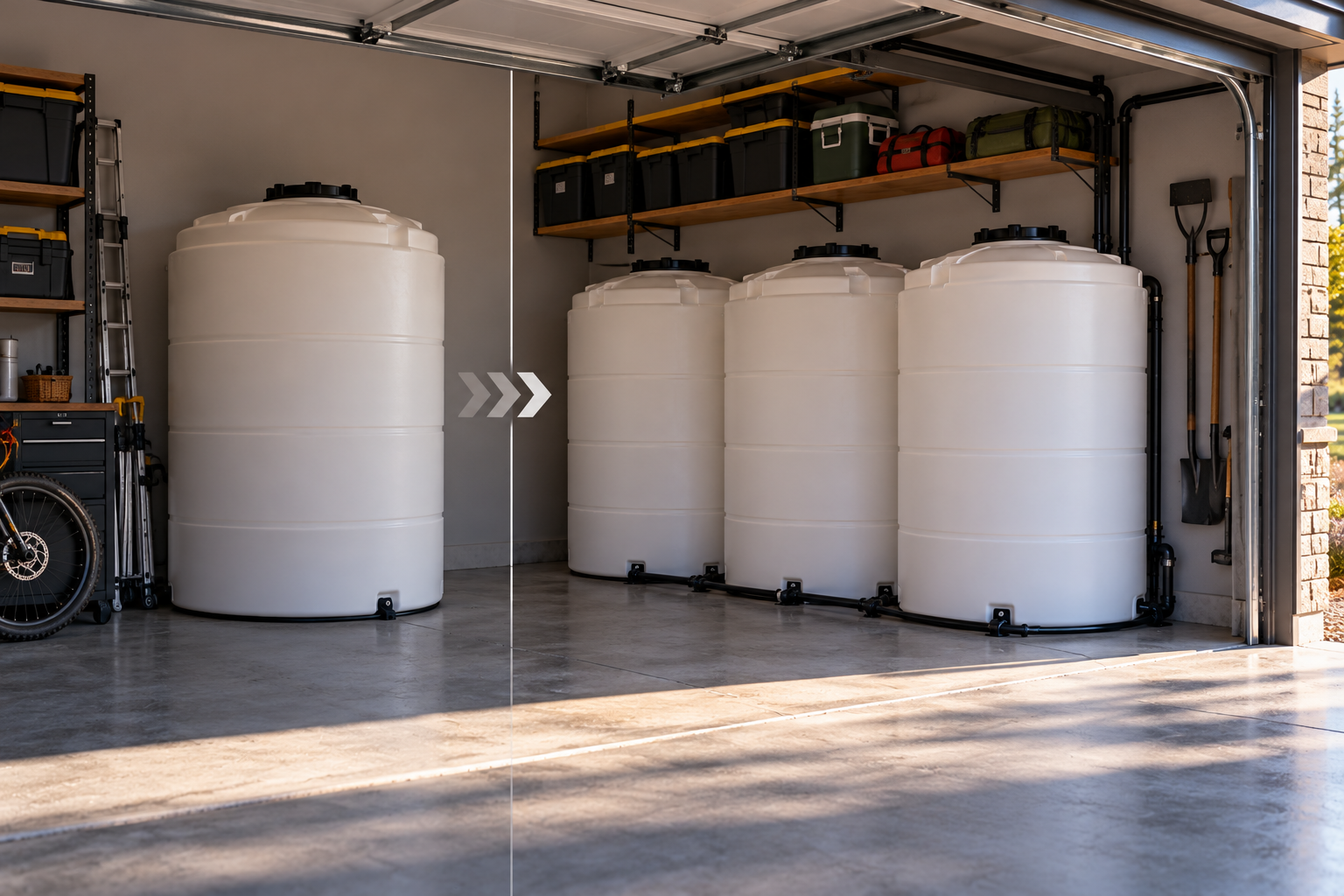
When adding water storage to a home, one of the first decisions is how much water you need. But there is another question that can be just as important: Should you install one large water storage tank, or start with a smaller system that can be expanded later?
Both approaches can work well. A single 500-, 1,000-, or even larger tank can provide a substantial amount of water storage from day one. A modular system takes a different approach, allowing you to begin with the storage you need today and add more capacity later as your household, property, or water demands change.
For homeowners on private wells, especially low-yield wells, that flexibility can be valuable. A couple may install a water storage system today and have children several years from now. A family may add an irrigation system, build a guest house, convert a shop into living space, or simply discover that their well produces less water during dry months than it did when the storage system was originally installed. The right amount of water storage today may not be the right amount five or ten years from now.
In this article, we'll compare modular water storage systems with single large-tank systems, explain where each approach makes sense, and look at why expandable storage can be particularly useful for growing homes.
What Is a Modular Water Storage System?
A modular water storage system uses multiple tanks that work together as one larger storage reserve. Instead of installing a single 600-gallon tank, for example, a homeowner might begin with approximately 200 gallons and add additional tanks later. Properly connected tanks can share the stored supply so the system effectively operates with the combined capacity.
The important idea is not simply that there are multiple tanks. It is that the storage system has been designed to expand. A homeowner can start with enough storage to solve the current water problem without having to predict exactly what life will look like ten years from now. If water demand increases later, another tank can be added.
That can be a major advantage for homeowners who know they need water storage but aren't sure how much their long-term needs will change.
What Is a Single Large-Tank System?
A single large-tank system takes the opposite approach. Rather than building storage incrementally, the homeowner installs most or all anticipated capacity at the beginning. This might mean installing one 500-gallon, 1,000-gallon, or larger polyethylene tank along with the necessary controls, plumbing, and booster pump.
There are situations where this makes perfect sense. If you already know that you need 1,000 gallons of usable storage, installing one appropriately sized tank may be simpler than connecting several smaller tanks together. Large tanks can also provide a lot of storage for their cost, particularly when the goal is simply to store a large volume of water.
The downside is that you are making a much larger capacity decision upfront. If you only really need 200 or 300 gallons, installing 1,000 gallons "just in case" may use more space and create more cost than necessary. On the other hand, if you install a 300-gallon single tank and later discover that you need 600 gallons, expanding the system may not be as simple as it would have been with a design intended for modular growth.
Water Needs Rarely Stay Exactly the Same
A common mistake when designing a water storage system is assuming today's water use will remain constant. Homes and families change. A two-person household becomes a four-person household. Children get older and begin taking longer showers. More laundry gets done. A spare bedroom becomes a guest room. Someone begins working from home. Landscaping gets installed, a garden gets larger, or another building is added to the property.
Even the well itself can change. A well that produces adequately during the wet season may slow down during a dry summer. Long-term groundwater conditions can also shift, particularly in areas where surrounding development puts additional demand on groundwater.
For a home with a strong 10 GPM well, many of these changes are easy to absorb. For a home relying on a 0.5 GPM or 1 GPM well, relatively small increases in daily water use can have a much larger impact. That is where expandable storage can become especially useful. Instead of trying to perfectly predict future water demand, a modular system can allow storage capacity to grow along with the household.
Storage Should Solve the Actual Water Problem
More storage is not automatically better, especially with low-yield wells. Suppose a family's well produces 1 gallon per minute. In theory, that equals as much as 60 gallons per hour or 1,440 gallons over a 24-hour period if that rate could be maintained continuously.
The problem may not be total daily production. The problem may be that the house wants 10 gallons per minute while showers, faucets, toilets, and appliances are being used, while the well can only replenish water at a fraction of that rate. A storage tank allows the well to produce water gradually and saves that water for high-demand periods.
If 215 or 300 gallons provides enough buffer to get the household through those high-demand periods, installing 1,000 gallons may not improve everyday performance very much. Once enough storage exists to bridge the gap between production and demand, additional capacity mainly provides a larger reserve.
That reserve can certainly be valuable, but it is important to understand what you are gaining from it. A modular system allows homeowners to find that balance without necessarily committing to maximum storage from the beginning.
The Biggest Advantage of Modular Storage: You Can Start Smaller
Imagine a couple moving into a new home with a low-producing well. Their current water use is relatively modest. They do laundry several times per week, have no irrigation, and rarely have more than two people in the house. A 200- to 300-gallon storage system may provide plenty of reserve for them.
They could install a 1,000-gallon tank because they might need more water someday, or they could install the capacity that makes sense today and expand it when that need actually arrives.
Several years later, they may have two children. Suddenly there are more showers, more laundry, more dishes, and significantly more daily water use. That is when another storage tank can be added. Several years after that, they might install landscaping or add a guest suite, and another tank may make sense.
The system grows when the demand grows. For many homeowners, that can be much more practical than sizing every water system around the highest imaginable future demand.
Modular Storage Can Make Better Use of Limited Space
Tank capacity isn't the only consideration. You also have to put the tank somewhere. Large tanks can require a significant amount of uninterrupted floor space, and they need to physically fit through whatever doors, gates, structures, or other access points stand between the delivery truck and the installation location.
This can become particularly important when storage is installed inside an existing garage, basement, utility room, or well house. There may be enough total floor area for several narrower tanks but not enough room for one very large-diameter tank.
Modular tanks can sometimes make it easier to use available space efficiently. Instead of needing one large open footprint, the storage can be arranged around the installation area. That does not mean several tanks always require less total space—they still need room, plumbing connections, and service access—but modular storage can give the installer more flexibility in how that capacity is arranged.
For existing homes where the water system has to fit into the space that is already available, that can be a major advantage.
When a Single Large Tank Makes More Sense
Modular storage has advantages, but there are also situations where one large tank is the better choice. If you know from the beginning that you need a very large volume of water, there may be little reason to build that capacity from multiple smaller tanks.
Consider a property that needs substantial irrigation storage, supplies livestock, supports multiple residences, or wants hundreds of gallons of dedicated emergency reserve. If the property has plenty of room for a large tank and the desired storage requirement is already known, one large tank can be straightforward.
There are also fewer tank-to-tank connections. Every additional tank in a modular system requires additional plumbing and fittings. A properly designed system should handle this without difficulty, but a single tank is inherently simpler from a storage-vessel standpoint.
Large outdoor tanks are especially common when space is not a concern and raw capacity is the primary goal. That is why this is not really a question of modular tanks being "better" than large tanks. It is a question of which design better fits the property and the homeowner's long-term plans.
Think About Usable Storage, Not Just the Number on the Tank
Whether you choose modular storage or a single large tank, tank capacity should not be considered in isolation. A 1,000-gallon tank does not mean a low-yield well suddenly produces 1,000 additional gallons of water every day. The well still has to fill it.
If a household uses 500 gallons per day but the well can sustainably replenish only 300 gallons per day, adding another 500 gallons of tank capacity does not fix the long-term water deficit. It simply delays the point when the stored supply runs out.
Storage works best when the well can produce enough water over time but cannot produce that water quickly enough to match peak household demand. A tank is essentially a buffer between production and consumption. It does not increase the actual amount of groundwater available to the property.
This is one reason starting with a reasonable amount of storage and monitoring how the system performs can be so useful. You may discover that the original capacity is plenty. If it isn't, a modular design gives you a clear path to increase it.
Growing Families Aren't the Only Reason to Expand
Household size gets most of the attention, but there are many reasons a home's water demand can increase. A homeowner might install a larger bathtub, add another bathroom, begin watering a garden, build a shop, add an accessory dwelling unit, or have relatives move onto the property.
Even changing habits can matter. Two people who are rarely home during the day may use water very differently after retiring or beginning to work from home. Seasonal demand can also be dramatically different from normal household demand.
A home may use relatively little water throughout fall and winter but experience much heavier use during summer because of irrigation, gardening, livestock, guests, or outdoor activities. With a modular system, homeowners can respond to actual demand instead of guessing at it years in advance.
Modular Systems Can Make Upfront Planning Easier
One of the hardest parts of choosing a water tank is the uncertainty. A homeowner may know the well is struggling but have very little data about actual water consumption. Should they buy 300 gallons, 500 gallons, or 1,000 gallons?
There is often a temptation to choose a huge tank simply because it feels safer. Sometimes that is the right decision, but if a system is designed to expand, the decision becomes less permanent.
You can install a reasonable amount of storage, see how quickly the household draws it down, and observe whether the well has enough time to replenish it between high-demand periods. If the storage level regularly gets lower than you are comfortable with, capacity can be increased. If the tank rarely gets close to empty, there may be no reason to add anything.
That gives the homeowner an opportunity to size storage using real-world information rather than assumptions.
The Well Harvester® Takes a Modular Approach

The Well Harvester® uses this expandable approach for low-yield well storage. The standard system includes 215 gallons of water storage, and if more capacity is needed, additional 215-gallon tanks can be integrated into the system.
That means storage can progress from 215 gallons to approximately 430 gallons, then 645 gallons, and continue increasing when a property requires more. For many households, this provides a practical balance because a homeowner does not necessarily have to dedicate the space or money for a very large storage tank from the beginning.
They can start with 215 gallons. If their household or water demand grows, another tank can be added.
But the Well Harvester is designed to do more than simply store water. With a low-producing well, the real challenge is collecting the available water without continually demanding more from the well than it can provide. The Well Harvester automatically manages collection from the well and stores that water for later household use.
The stored supply is then pressurized for the home by a separate booster pump, allowing household water demand to be separated from the well's instantaneous production rate. The system can deliver up to 20 GPM from storage and approximately 60 PSI, even though the well itself may be producing water much more slowly.
This is an important distinction. Adding three or four tanks to a poorly managed low-yield well does not necessarily create a good water system. The storage needs to work together with the well. The Well Harvester combines the two sides of the problem: managing how water is collected and providing expandable capacity for storing it.
That makes additional tanks useful when they are actually needed rather than using tank size alone to compensate for poor well management.
An Example: A Family That Grows Over Time
Consider a young couple with a well producing approximately 0.75 GPM. At that rate, the well can theoretically produce 45 gallons per hour. Over a full day, that can add up to a significant amount of water, but 0.75 GPM is nowhere near enough to directly supply a shower, washing machine, toilet, and sink running at the same time.
Storage solves that difference.
The couple begins with approximately 215 gallons. Because there are only two people in the home, the tank has plenty of time to recover between periods of heavier use. Five years later, they are a family of four. They are using more water, and the morning and evening demand periods are heavier.
The original storage still works most days, but during weekends with laundry, baths, and guests, the tank level occasionally gets lower than they would like. Instead of replacing the original tank, they add another 215 gallons, bringing their total storage to approximately 430 gallons.
Years later, they add an irrigation system or a guest area. If the well has enough total production to support the additional water use, another tank can be added. The original investment was not thrown away. It became the first stage of a larger system.
That is the real value of modularity.
When More Storage Won't Solve the Problem
There is one important warning with any expandable tank system: before adding storage, make sure the well has enough production to refill it.
Suppose a household uses 400 gallons per day but the well sustainably produces only 250 gallons per day. Installing 1,000 gallons of storage could make the problem seem solved for a few days, but the household is still using 150 gallons more each day than the well can replace.
Eventually, the tank will empty. Adding another tank would only extend that timeline.
In this situation, the solution may involve reducing demand, improving well management, identifying another water source, or evaluating whether the well's production can be improved. This is why Epp Well Solutions looks at more than tank capacity when evaluating a low-yield well.
The goal is not to install the most gallons possible. The goal is to create a water system where well production, storage capacity, and household use work together.
So Which Is Better: Modular or One Large Tank?
For a property with a known, consistently high storage requirement and plenty of installation space, a single large tank may be the simplest answer. For a home where water needs may change, space is more limited, or the homeowner does not yet know exactly how much reserve will be necessary, modular storage offers significant flexibility.
A simple way to think about the decision is:
Choose modular storage when you want to start with the capacity you need now, preserve the ability to expand, have changing household demands, or need more flexibility in how tanks fit into the available space. Choose a single large tank when you already know you need a large amount of storage, have plenty of installation space, and value having the full reserve available from day one.
Neither approach changes how much water the well actually produces. That still has to be part of the calculation.
Build the System Around Your Home, Not Just Today's Number
Water storage systems can remain in a home for many years, and your household may look very different at the end of that time than it did when the system was installed. That is why it can be helpful to think beyond one tank-size calculation.
Consider how much water you need today, how much you might reasonably need in the future, how difficult it would be to expand the system later, and whether one large tank or several smaller tanks would fit the property better. Most importantly, make sure the well can actually produce enough water over time to support the household's current and future demand.
For some properties, installing one large tank from the beginning is the obvious answer. For others, the ability to start smaller and expand later provides a better path.
A modular system lets your water storage grow with the home rather than requiring you to design today's system around a future you cannot fully predict. For low-yield wells, where the balance between production, storage, and demand is especially important, that flexibility can make it much easier to build a system that works today and continues working as life changes.