Tandem Wells vs. Storage Tanks: Which Is Better for Low-Yield Wells?
If your well isn’t keeping up with your household’s water demands, you’re not alone. Thousands of homeowners across the country struggle with low-yield wells that produce water more slowly than their families use it. The result can be frustrating: showers that run cold, irrigation systems that strain the well, and constant worry about running out of water during periods of high demand.
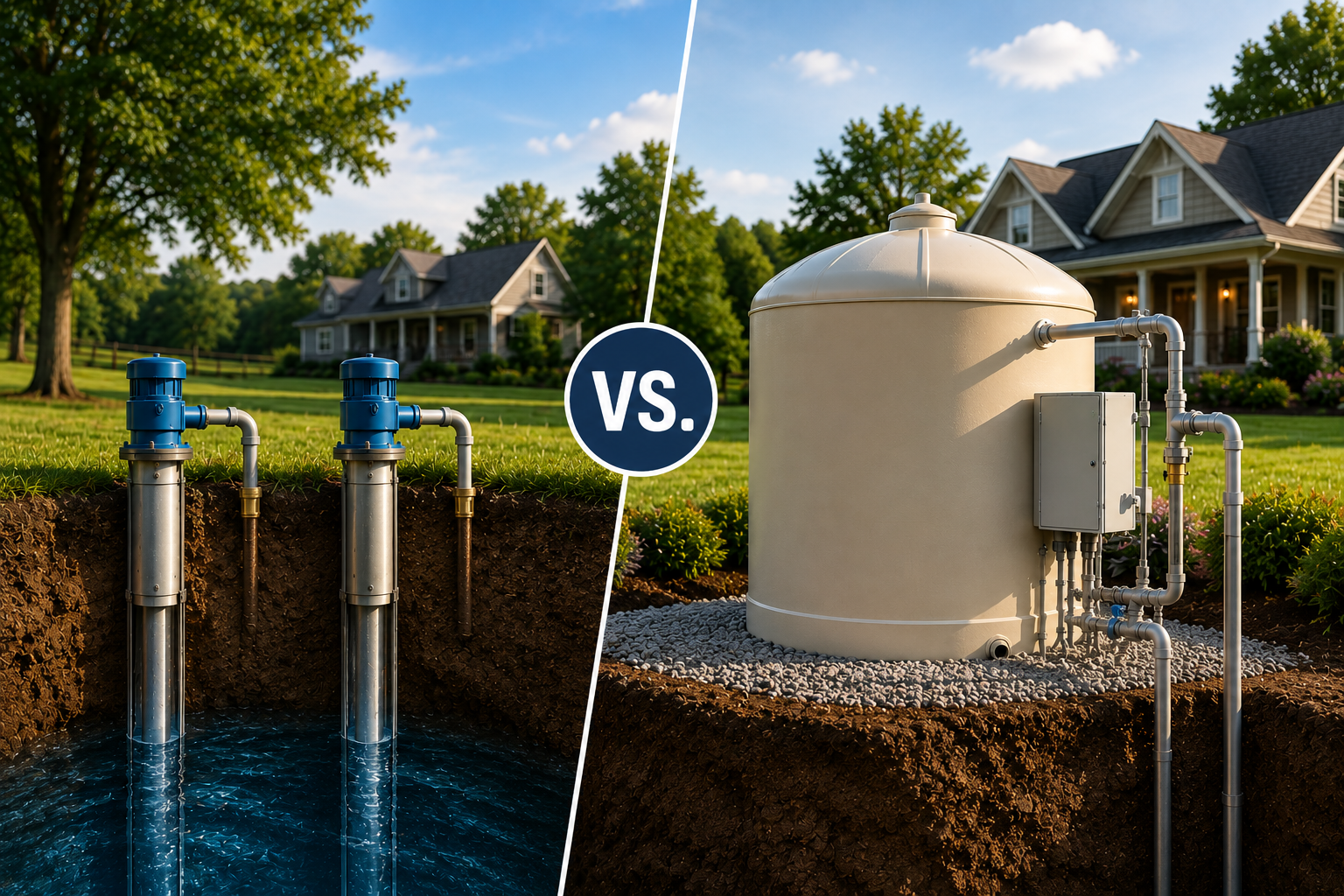
When faced with a low-producing well, many property owners begin searching for ways to increase available water. Two common solutions often emerge during that search: drilling a tandem well or installing a storage tank system. Both approaches can improve water availability, but they accomplish that goal in very different ways.
Understanding the differences between tandem wells and storage tanks can help homeowners make a smarter investment and avoid spending thousands of dollars on a solution that may not deliver the results they expect.
Before deciding between these approaches, it’s worth exploring the full range of solutions for low-yielding wells, since the best option often depends on your well’s production rate, household demand, and long-term water goals.
Understanding the Low-Yield Well Problem
Before comparing solutions, it’s important to understand the actual challenge low-yield well owners face.
Many wells don’t fail because they stop producing water entirely. Instead, they fail to keep pace with demand. A well may produce only one or two gallons per minute while a household might use hundreds of gallons throughout the day. During short periods of heavy use, water leaves the well faster than it can naturally replenish.
This mismatch between production and demand creates the appearance of a water shortage, even when the well continues to generate a significant amount of water over a 24-hour period.
The key question becomes: How can homeowners capture and use all of the water their well produces without over-pumping the aquifer or damaging equipment?
That’s where tandem wells and storage tank systems enter the conversation.
What Is a Tandem Well?
A tandem well refers to the practice of drilling a second well on the same property to supplement the production of an existing well. The goal is straightforward: increase the total amount of groundwater available to the property by drawing water from two separate sources.
In theory, if one well produces two gallons per minute and a second well produces three gallons per minute, the combined output could provide five gallons per minute.
For some properties, this approach can be effective. A second well may tap into a different section of the aquifer or reach a more productive water-bearing formation. When successful, a tandem well can significantly improve overall water availability.
However, drilling an additional well comes with several challenges.
The biggest challenge is uncertainty. No contractor can guarantee exactly how much water a new well will produce before drilling begins. Homeowners may invest thousands of dollars only to discover that the second well produces less water than expected.
Many homeowners investigate several methods before drilling another well. Common alternatives include hydrofracking, well rehabilitation, storage systems, and other strategies designed to increase well yield and improve water availability.
In some situations, the two wells may even draw from the same groundwater source. If that happens, the additional production may be far less than anticipated because both wells are effectively competing for the same water supply.
The costs can also be substantial. Drilling, casing, pumps, electrical work, trenching, permits, and site preparation can quickly turn a tandem well project into a major investment.
For homeowners already dealing with water shortages, that’s a significant financial risk.
How a Well Water Storage Tank Increases Available Water
Storage tank systems take a completely different approach.
Rather than trying to increase the amount of water coming out of the ground at any given moment, storage tanks focus on capturing every gallon the well produces throughout the day.
Many low-yield wells produce more than enough water over a 24-hour period to meet household needs. The problem is that production occurs slowly while demand occurs in bursts.
A storage system allows the well to pump water gradually into a reservoir tank or water holding tank where it can accumulate throughout the day for later use.
Water accumulates continuously, even when nobody is using it. Later, when a shower, washing machine, irrigation system, or multiple fixtures require water simultaneously, the stored supply is available immediately.
Instead of depending on the well to meet peak demand in real time, homeowners rely on stored water that has been collected over many hours.
This simple concept often transforms the performance of a low-producing well.
The Well Harvester® Advantage

For homeowners seeking the benefits of storage while maximizing the efficiency of their existing well, the Well Harvester® offers a more advanced solution.
Unlike basic storage systems that rely on simple timers or manual controls, the Well Harvester continuously monitors well conditions and automatically manages water production. The system is designed specifically for low-yield wells, helping homeowners harvest every available gallon while protecting the well from over-pumping.
By combining intelligent controls, atmospheric storage, and integrated pressure management, the Well Harvester transforms a low-producing well into a dependable water supply system.
The technology allows the well to operate at a pace that matches its natural recharge rate while storing water for later use. Instead of forcing the well to keep up with household demand, the system works with the well’s production capabilities.
This automated approach reduces stress on equipment, improves reliability, and provides peace of mind for homeowners who have struggled with water shortages.
For many low-yield well owners, the Well Harvester delivers the practical benefits they hoped to achieve through drilling a second well—without the uncertainty and expense associated with new drilling projects.
Comparing Real-World Water Output
When homeowners ask which solution boosts output more, the answer depends on how “output” is defined.
If output refers strictly to groundwater production, a successful tandem well can increase the total amount of water entering the system.
However, if output refers to the amount of usable water available when the household needs it, storage tanks frequently deliver a greater practical benefit.
Consider a well producing two gallons per minute. Over 24 hours, that well can generate approximately 2,880 gallons of water. Most households use significantly less than that amount on a daily basis.
Without storage, much of that production capacity goes unused because water is needed during concentrated periods throughout the day.
With storage, nearly every gallon produced can be captured and utilized.
This distinction is important because homeowners are usually trying to solve a usability problem rather than a production problem. They don’t necessarily need more groundwater. They need reliable access to water when demand spikes.
Storage systems excel at solving that challenge.
The Cost Difference
Cost is another major factor in the tandem well versus storage tank decision.
A second well represents a new drilling project with uncertain results. Geological conditions, drilling depth, permit requirements, and regional labor costs all influence the final price.
In some areas, homeowners may spend tens of thousands of dollars before determining whether the additional well will provide meaningful improvement.
Storage tank systems generally offer a more predictable investment. Because they utilize the existing well, much of the uncertainty associated with drilling is eliminated.
Rather than gambling on unknown underground conditions, homeowners focus on maximizing the performance of the water source they already own.
This approach often provides a higher return on investment, particularly when the existing well produces an adequate daily volume but struggles to satisfy peak demand.
Reliability During Seasonal Changes
Low-yield wells often experience seasonal fluctuations.
Drought conditions, changing groundwater levels, and increased summer demand can reduce well performance during certain times of year. These seasonal variations create additional challenges for homeowners who depend entirely on instantaneous well production.
A storage system provides an important buffer against these fluctuations.
When demand increases or production temporarily decreases, stored water helps bridge the gap. The household gains greater flexibility and resilience without placing additional stress on the well.
A tandem well may help offset seasonal declines if the second well accesses a different water source. However, if both wells depend on the same aquifer conditions, seasonal limitations may affect both systems simultaneously.
When a Tandem Well Makes Sense
A tandem well may be the right solution when an existing well produces extremely little water, when geological studies indicate a high likelihood of reaching a separate productive aquifer, when overall property demand exceeds what the current well can generate over a full day, or when future expansion plans require significantly more water production. In these situations, additional groundwater production may be necessary to meet long-term needs.
Frequently Asked Questions
Does a tandem well always increase water production?
Not necessarily. A second well may access a more productive water-bearing formation, but results vary significantly based on local geology. In some cases, both wells draw from the same groundwater source, limiting the increase in production.
Can a storage tank make a low-yield well feel like a high-yield well?
In many cases, yes. A storage system captures water continuously throughout the day and makes it available during periods of high demand. This can dramatically improve water availability without increasing actual groundwater production.
Is a storage tank cheaper than drilling a second well?
For many homeowners, yes. Storage systems generally involve less uncertainty because they maximize the performance of an existing well rather than relying on unknown underground conditions.
What is the best solution for a low-yield well?
The best solution depends on the well’s production rate, recharge characteristics, and household demand. For many properties, an automated storage system such as the Well Harvester® provides a reliable and cost-effective alternative to drilling another well.
Final Thoughts
When comparing tandem wells and storage tanks, there is no universal answer that fits every property. A successful tandem well can increase groundwater production, but it comes with significant uncertainty and expense.
Storage systems focus on maximizing the value of the water already being produced. For many homeowners, this approach delivers greater practical improvements in water availability, pressure, and reliability.
Before investing in a second well, it’s worth evaluating whether your current well is producing enough water over time and whether a properly designed storage solution could unlock its full potential.
Many homeowners discover that modern storage systems provide a more predictable and cost-effective alternative than drilling another well, especially when their existing water source is capable of meeting daily demand. Understanding all available solutions for low-yielding wells can help identify the best path forward.
Whether you’re considering a tandem well, a storage-based solution, or an advanced system like the Well Harvester®, understanding how your well produces and uses water is the first step toward making the right investment.